
Scott County moves to ISO Class 2 after fire department investments
Get AI-powered insights, summaries, and transcripts
Subscribe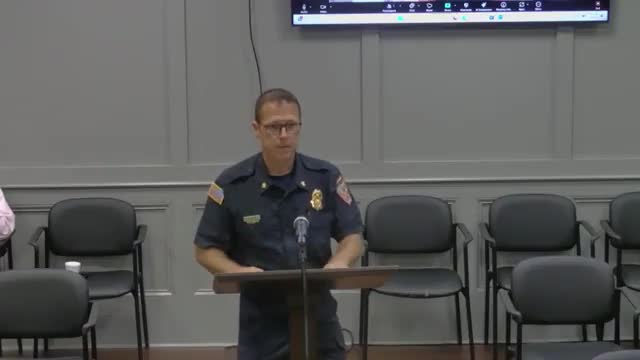
Summary
Scott County's fire department received an improved Insurance Services Office Public Protection Classification, moving from Class 3 (3y) in 2016 to a split Class 2y effective Aug. 1, 2025, reflecting investments in staffing, training and equipment and leaving the county at 83.4 points (90+ needed for Class 1).
Scott County’s fire department received a higher Public Protection Classification from the Insurance Services Office (ISO), County Judge Masters said at a Sept. work session, moving from a 2016 Class 3y to a split Class 2y effective Aug. 1, 2025. Chief John Ward attributed the change to additional staffing, updated apparatus and increased training hours, and thanked the fiscal court for funding those investments.
The upgrade matters because ISO’s Public Protection Classification (PPC) is used by insurers to help set fire-insurance rates; Chief John Ward said better PPC grades generally correspond to lower insurance premiums for properties in the evaluated areas. The ISO evaluation assesses three areas: emergency communications, fire department operations and water supply.
Ward explained that the “split” designation reflects different classifications within the county depending on distance to a fire station and proximity to a credible water supply. Under ISO rules, the first number applies to properties within five road miles of a fire station and within 1,000 feet of a usable water source; the second number (with an “x” or “y”) applies to areas within five miles of a station but beyond 1,000 feet of a credible water supply. Areas beyond the five-mile deployment distance remain a Class 10.
Chief Ward highlighted specific scoring gains: company personnel (a 15-point category) rose from 5.2 in 2016 to 11.41 in 2025, a change he linked directly to the fiscal court’s approvals to add staff. He also noted a small increase in the community risk reduction category (from 4.24 in 2016 to about 4 points this year) and said the recently created fire marshal position—with Fire Marshal Cromer conducting business inspections and preplans—should allow the county to capture more of the 5.5 available community-risk points in future evaluations.
Ward said Scott County’s total score is 83.4; he told the court that a Class 1 requires 90 or more points. He proposed continuing to pursue improvements—more training hours, deployment analysis for potential station siting and further personnel increases—to aim for a Class 1 in future cycles. He also distributed the ISO letter and a packet that breaks down the department’s points by communications, fire department operations and water-supply scoring.
Members of the court asked for follow-up detail on which counties or counties’ fire departments hold Class 1 or Class 2 ratings and which of those are county-based rather than city-based; Ward said he had asked ISO for that breakdown but had not yet obtained it. The court and staff agreed to share the ISO letter and to prepare a press release and social-media notice announcing the upgrade.
No formal vote or ordinance resulted from the presentation; the item was informational and the court directed staff to provide follow-up materials and to collaborate on public messaging.