
Seaford council approves code changes to permit retail adult‑use marijuana sales
Get AI-powered insights, summaries, and transcripts
Subscribe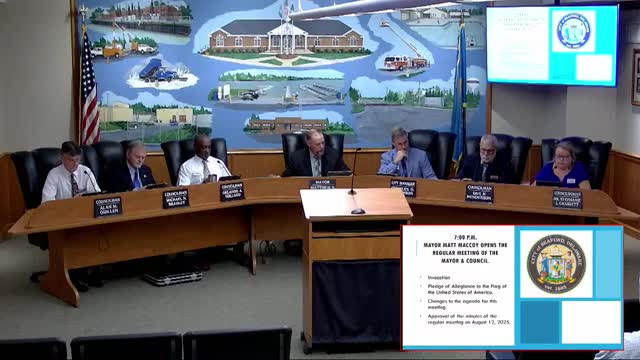
Summary
The Seaford Mayor and Council approved a second‑reading amendment to municipal code Chapter 15 to permit retail adult‑use marijuana sales, remove a federal rescheduling requirement and set store hours; the measure passed after public comment and a divided council debate.
Seaford Mayor and Council voted Tuesday to adopt amendments to Chapter 15 of the municipal code that allow retail adult‑use marijuana sales in the city, delete a federal rescheduling requirement from local zoning rules and set operating hours for retail outlets.
The measure cleared a second‑reading motion and passed on a roll‑call vote after a public hearing and comments both for and against. The new code language removes a provision tying local retail permission to federal rescheduling, makes the use permissive rather than by special exception in the identified zone, and establishes hours of operation of 9 a.m. to 10 p.m. Monday through Saturday and noon to 8 p.m. on Sundays.
Why it matters: The action changes local zoning language to align Seaford’s code with state law allowing conversions of some medical cannabis businesses for recreational sales. Council members debated public‑safety concerns raised during public comment and legal risks of denying conversions; one council member opposed the amendment, while the majority said restricting locations and hours would allow local control and avoid litigation.
Council action and vote Councilwoman Stephanie Grasset moved to approve the second reading of the amendments to Chapter 15 as presented; Vice Mayor Dan Henderson seconded. The roll‑call vote was: Dan Henderson, yes; Stephanie Grasset, yes; Orlando Holland, yes; Mike Bradley, no; Alan Quillen, yes. The motion passed and the amendments were adopted as presented. The ordinance text amends sections 15.22.2(c), 15.22.3(h) and 15.52.5(c) of the municipal code.
What changed in the code - The local ordinance deletes language that had conditioned retail retail adult‑use sales on federal rescheduling. Previously, the city had a rescheduling clause tied to local zoning. Council discussion noted that state law (House Bill 408) created a conversion pathway at the state level for certain medical operators. - The amendment removes a requirement that retail operations be allowed only by special exception in the cited zone, making the use permitted where the section applies. - Operating hours for retail sales were set at 9 a.m.–10 p.m. Monday–Saturday and 12 p.m.–8 p.m. Sunday.
Public comment and council discussion Three members of the public spoke during the hearing. Resident Frank Parks, who identified himself as director of the Fisherman Foundation, urged council members to oppose retail availability and cited health and social concerns, saying cannabis legalization has led to “psychosis hospitalization visits” and increased impaired driving in other states. Emily Wilkins, who identified herself as a cannabis specialist and industry educator, countered that regulated dispensary products differ from street supply, saying, “This is safe, consumable product” and offering to let council members visit regulated facilities. Resident Paul Durrell, a medical marijuana cardholder, said local retail outlets would reduce inconvenience for people who currently travel out of town to buy medical product.
Council debate reflected those tensions. Councilman Mike Bradley said he would be “the lone wolf” in opposing the change, arguing it would increase police workload and expose people recovering from substance use. Councilman Alan Quillen said he was not a full supporter of recreational marijuana but favored the amendment to establish local rules, limit locations and avoid likely legal challenges experienced by other municipalities; he voted yes.
Next steps and legal context Council members discussed that the ordinance change implements local zoning updates in response to state law allowing conversion licenses (House Bill 408). The motion approved the second reading; the transcript did not specify an effective date or administrative steps for licensing and permitting. Approvals, licensing and any business‑level permitting would follow separate administrative processes not decided at Tuesday’s meeting.