
St. Lucie expands University of Florida literacy program across K–2 after pilot showed early gains
Get AI-powered insights, summaries, and transcripts
Subscribe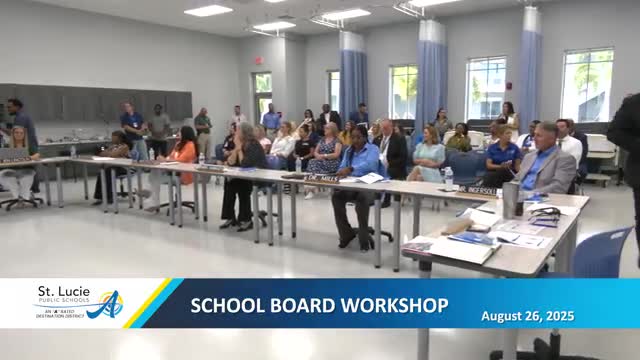
Summary
St. Lucie Public Schools presented the districtwide rollout of the University of Florida Literacy Institute (UFLI) for grades K–2 at its Aug. 26 board meeting, citing pilot data and describing training, fidelity checks and home‑school materials to support implementation.
St. Lucie Public Schools officials on Aug. 26 described a districtwide rollout of the University of Florida Literacy Institute, known as UFLI, saying the phonics-based program produced measurable early gains after a February pilot and a first full year of implementation in the 2024–25 school year.
Denise Rodriguez, executive director of Teaching, Learning and Leading for St. Lucie Public Schools, told the school board that UFLI moved from pilots in February 2024 to a districtwide program in 2024–25 and that the district is continuing supports for teachers and administrators. "Today, we are going to be really talking about the implementation of the University of Florida Literacy Institute, which we commonly refer to as UFLI," Rodriguez said.
The presentation emphasized why the district chose UFLI and how it is being implemented at scale. Heather Bellefoe, director of elementary curriculum, framed the program within the “science of reading,” saying systematic phonics instruction targets the word-recognition strand of reading and is designed to make decoding automatic so students can focus on comprehension. "Seventy percent of students who have reading difficulties, the difficulty lives squarely in that word recognition component," Bellefoe said.
District staff presented data from midyear and end‑of‑year diagnostics. After a half year of pilot implementation, the district reported kindergarten phonics scores on the I‑Ready diagnostic increased by 5 percentage points, first grade by 2 points and second grade by 4 points. On end‑of‑year reading proficiency, the district said kindergarten rose 10 percentage points (versus a 2‑point statewide increase), first grade rose 4 points (versus a 2‑point statewide increase), and second grade fell 1 point (the state fell 2 points). The presentation summarized the district’s early‑reading scorecard as 11 points higher than the state in early reading proficiency.
Officials described classroom routines and fidelity systems: UFLI lessons run across two days with review, explicit phonics instruction, practice with decodable texts and a fifth‑day quick assessment for progress monitoring. Bellefoe said lessons are interleaved so students practice given skills ‘‘anywhere from 50 to 300 times’’ over the course of core instruction, and the district uses screeners including DIBELS and the I‑Ready diagnostic to guide intervention and placement.
Rodriguez and Bellefoe credited the partnership with the University of Florida Literacy Institute for training and course access. Bellefoe said UF provides a foundational course and coaching support; she said the district receives that 6‑hour course for free through the partnership and that UFLI staff continue to consult with the district. The presentation also noted a high‑visibility classroom visit for a filmed interview with author and philanthropist James Patterson, arranged by UFLI staff.
The board heard how the district supports teachers and administrators: an implementation guide for each lesson, in‑person training, instructional rounds with principals, an online Canvas course, model videos, and coach support to maintain fidelity. Staff said they are extending a school‑to‑home connection with a one‑page weekly practice guide designed for brief parent practice sessions (staff said 2–6 minutes is typical) and online videos demonstrating sounds and routines.
Board members and guests praised the program in public remarks. An unnamed board member, after visiting classrooms, said, "I'm definitely sold out on UFLI." Staff also read teacher and parent testimonials describing individual student progress, and a short audio clip played in the meeting showed a kindergarten student reading after the program's instruction.
No votes or formal board actions were taken during the presentation; the session consisted of a program briefing, questions from board members, and recognition of teachers and district staff involved in the rollout.
Questions from board members centered on timeline, home‑school materials and continuity for students who do not receive parent practice at home. Rodriguez said the district started pilots in February 2024, completed a first full year in 2024–25 and has begun expanding home‑school resources this school year. On students missing out on at‑home practice, Bellefoe said classroom instruction provides the repeated exposures built into the core lesson and that the district monitors progress and pulls students into small‑group interventions as needed.
Staff identified next steps as refining fluency supports, strengthening vocabulary and background‑knowledge work, expanding the school‑to‑home connection and continuing fidelity monitoring and professional learning. School leaders and teachers were recognized at the meeting for leading classroom implementation.
Discussion only — no contractual approvals, ordinance or budget vote was recorded during the presentation. Staff said the program is an ongoing partnership with UFLI and that district managers and coaches will continue to report on fidelity and outcomes.