Get Full Government Meeting Transcripts, Videos, & Alerts Forever!
Get email alerts on the Transportation topic
No spam. Unsubscribe anytime.
N.D. DOT outlines right-of-way process, landowner protections and tribal approvals
Summary
Megan Eisenhower of the N.D. Department of Transportation(Williston District) explained how right-of-way is acquired, negotiated and handled during construction, including appraisal thresholds, easement types, utility relocation rules and additional steps when projects affect tribal land.
Megan Eisenhower, N.D. Department of Transportation Williston District staff, explained the department—s right-of-way acquisition and construction procedures at a district presentation on Oct. 11, 2025, emphasizing how the agency notifies landowners, values property and addresses disputes during construction.
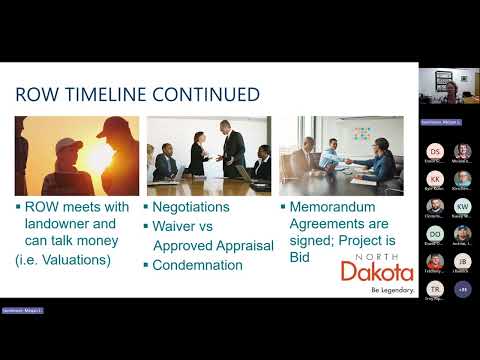
Eisenhower said the process typically begins with traffic surveys and programming, moves through preliminary engineering and surveying, and then involves title research, owner contact and valuation before any payments or work begin. "Right of way is an important topic to understand as we interact with the public and adjacent landowners on construction projects," she said.
The presentation summarized legal and administrative safeguards and how they apply in practice. The N.D. Department of Transportation (NDDOT) uses appraisals to determine fair market value, and a second reviewer establishes the compensation offer. For small acquisitions that NDDOT staff determine are uncomplicated and valued under $35,000, the agency may prepare a waiver of valuation instead of a full appraisal; Eisenhower said that threshold had recently risen from $10,000 to $35,000. If negotiations cannot resolve an acquisition, the department may pursue condemnation under eminent domain laws; Eisenhower described condemnation as a last resort and said the laws require payment at fair market value.
Eisenhower described three common transaction types: temporary construction easements, permanent easements and fee purchases (warranty deeds). A temporary construction easement is typically valid for one construction season and can remain in effect for up to five years after signing; if a project extends beyond five years, the easement must be renegotiated. A warranty deed transfers ownership to the NDDOT and can trigger relocation assistance when families must move.
She walked through a written purchase agreement used by the department, SFN 6776, called a memorandum of agreement. That form documents itemized provisions such as fence removal, drainage or cattle passes, payment timing and tenant notification requirements. Eisenhower showed an example from Highway 85 in which special provisions were added: a temporary fence installed before removing a permanent fence, material specifications (four-line fence, 12.5-gauge, with two barbed wires and specific spacing), and staged payments when a project spans two construction seasons.
Eisenhower said the department places importance on incorporating memorandum provisions into construction plans and special provisions so contractors follow landowner agreements. She used a Highway 85 example where the department included a landowner—s fence specifications in plan notes and required landowners to be notified in writing at least 30 days before fence removal and notified again verbally immediately before removal.
When disputes arise during construction, Eisenhower advised contractors and engineers to first listen to landowners, then review contract plans and the memorandum of agreement. If concerns are not addressed in the contract, the right-of-way agent should be contacted. Eisenhower said contractors should not negotiate directly on compensation: "Once the contract is bid, contact should be directly with the DOT right of way agents first." She added that consultants may assist with acquisition, but the department maintains at least one NDDOT right-of-way agent on each project.
Eisenhower described how the department handles utilities: if a utility lies in existing right of way the utility company is generally required to move it at its own cost; if the utility lies within newly acquired NDDOT right of way, the department participates in relocation costs. She noted that utility work is often ranked in contract plan sheets and many projects require on-site utility personnel or potholing to confirm depths before work begins.
She also described negotiated, owner-funded options: on Highway 85 one family asked for a cattle pass that was not in the original plans and agreed to pay $81,900 as their share to have NDDOT install it. In another example the department purchased a 65-by-150-foot area when grading limits required it.
Eisenhower warned that projects affecting tribal lands typically require additional steps and time. There are five tribes and one Indian community with land at least partially in North Dakota; when tribal property is involved, right-of-way staff generally need permission to access parcels, appraisals can take months for approval, and tribal resolution or permission and Bureau of Indian Affairs approval are required before the federal grant of right of way can proceed. "The DOT does not condemn if it's on tribal land," Eisenhower said, noting that condemnation on tribal land is handled at the federal level and can take many years.
Eisenhower closed with resources for staff and landowners: the NDDOT right-of-way manual, a pamphlet titled Information for Highway and Street Projects, and the department—s GIS plat files that show current and previously acquired right-of-way lines. She invited questions and said staff contacts for specific projects (for example, Stacy for Highway 85) are available through the department.
Eisenhower took several follow-up questions from meeting participants about difficult negotiations and common landowner issues such as signs and farming on newly acquired right of way. She said advance contact and clear documentation during negotiations can help reduce disputes and reiterated that right-of-way agents keep a diary of interactions and that memoranda of agreement become part of the construction plans and contract documents.