
Fargo Public Schools lays out multi-pronged plan to boost belonging, tighten attendance tracking and standardize behavior reporting
Get AI-powered insights, summaries, and transcripts
Subscribe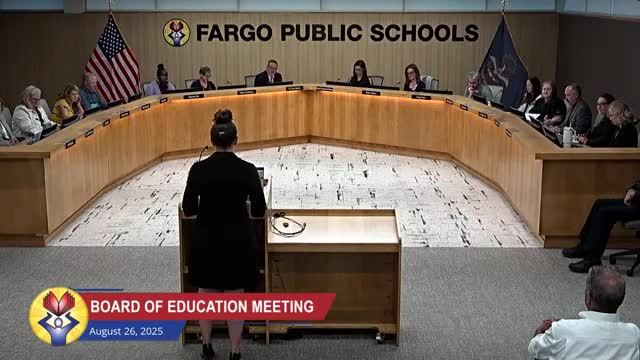
Summary
District leaders presented Strategic Initiative 2 updates to the Fargo Board of Education, reporting an 8-point gain on a single-item belonging measure, acknowledging inconsistent behavior reporting across buildings, and unveiling operational changes aimed at reducing chronic absenteeism and improving school safety.
Fargo Public Schools officials told the Fargo Board of Education that the district’s Strategic Initiative 2 — focused on positive school culture and safety — is showing early signs of improvement in student belonging while district leaders also flagged continuing concerns about behavior-reporting consistency and post‑pandemic attendance declines.
The district’s presentation, given to the board by Dr. Saar and other staff, emphasized that belonging rose by eight percentage points between the two most recent spring surveys. Dr. Saar said district work on school improvement plans and a new, broader belonging survey were intended to move the metric beyond a single-question snapshot "because a student or a staff member's sense of belonging is so much more than just a single question." He added, "Belonging really is this equation of peer connections, positive relationships with adults, and [an] inclusive school environment."
Nut graf: The update matters because the district tied belonging, behavior and attendance together as interlocking priorities. Officials said better, more consistent behavior reporting and earlier attendance alerts are necessary to identify students at risk and to target supports before chronic issues develop.
On behavior reporting, district staff reported stepladder progress but also inconsistencies across buildings: some incidents recorded in alternative PowerSchool locations were not appearing in the district’s central behavior‑reporting form. Staff said that inconsistency complicates year‑to‑year comparisons and that the district revised its code of conduct this summer to emphasize restorative responses and to reduce reliance on exclusionary discipline. The district also used the PBIS tiered fidelity inventory (TFI) in many schools to identify needed supports and to develop lessons for common expectations.
Attendance was described as the Strategic Initiative 2 measure with the greatest short‑term risk. District staff said the state definition of chronic absenteeism — hitting 10% of possible school days missed — remains the standard to identify students as chronically absent. "So chronic absenteeism is defined by days missed. And so anytime you hit that 10% of the days possible to attend, then you would be classified as that chronic absenteeism," Dr. Saar told the board.
To address attendance, the district said it has partnered with EAB to focus interventions on the "movable middle" of students at risk of becoming chronically absent. New operational steps include automated 3‑day and 6‑day absence alerts to building teams (previously the first district report came after nine absences), clearer attendance reporting instructions on the district and school websites, monthly "attendance nudges" for newsletters and social media, and expanded community resource links (food, transportation, housing). District leaders said the change to earlier alerts could temporarily increase reported absence figures as the system becomes more consistent.
On safety measures, district safety coordinator Josh Smith described the development of a "site safety score" that will combine multiple data points into four pillars and produce a building‑level score for principals to review. Smith said the dashboard is under development and that the district expects to use it to compare buildings, set benchmarks and identify targeted improvement steps.
Board members pressed for disaggregated data and staff metrics. Board member Namal asked whether belonging data can be broken out by student groups; district staff said the previous Cognia survey was anonymous and did not allow disaggregation but that they will move to a different survey tool this year that may permit deeper breakdowns while balancing anonymity concerns. Several members also asked about staff belonging and retention; the human capital office reported early retention figures and said follow‑up evaluation will examine whether highly rated teachers are returning.
The board voted to accept that reasonable progress had been made on Strategic Initiative 2 for the 2025‑26 school year. Robin Nelson moved the motion; Nikki seconded. The motion passed on roll call 9–0.
Ending: District leaders said they will hold monthly checkpoints with building leaders to treat the strategic measures as operational, ongoing work — not year‑end evaluations — and they warned that some short‑term increases in reported incidents or absences could reflect better, more consistent reporting rather than worsening conditions.