
North Dakota Supreme Court hears appeal in parental-rights case focusing on alleged alienation and abandonment
Get AI-powered insights, summaries, and transcripts
Subscribe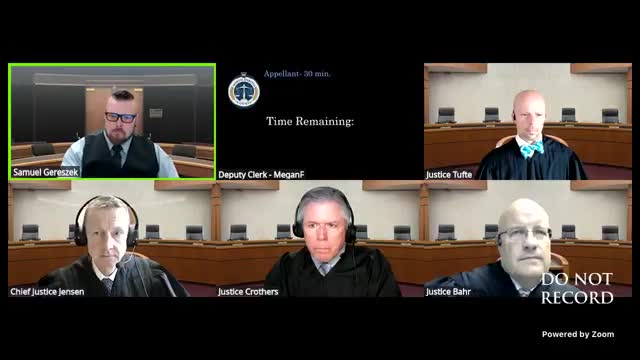
Summary
At an oral argument before the North Dakota Supreme Court (date not specified), appellant's counsel argued the district court erred in finding parental abandonment and failed to account for the mother’s actions that he says actively prevented contact; justices questioned application of child-support and incarceration rules across jurisdictions.
The North Dakota Supreme Court heard oral argument (date not specified) in an appeal of a district-court order terminating parental rights and clearing the way for adoption, with Samuel Jurasick, attorney for the appellant, arguing the lower court misapplied the law and overlooked evidence that the children’s mother actively kept the father from contact.
The appeal centers on whether the district court correctly found abandonment and failure to support, or whether the record instead shows the mother’s conduct — including moving repeatedly, declining child-support enforcement and a handwritten instruction saying “do not tell him where I live” — frustrated the father’s efforts to remain in the children’s lives. Jurasick told the court that “he has been trying to reach her,” and pointed to testimony and documents he said show the mother sought to hide the children’s whereabouts from the father.
Under the appellant’s account, the father had regular contact with the children from early 2017 to about February 2019; the mother removed the children in December 2019 and limited the father’s access thereafter. Jurasick described a March 2020 encounter in a Walmart in which the father tried to contact the mother and told his child he would “get court papers so he can see you again.” He said the family later relocated out of state to Cavalier, North Dakota, and that the mother declined continued child-support enforcement after receiving TANF benefits, writing a note instructing authorities not to disclose her address to the father.
Jurasick argued two principal errors to the justices: (1) the district court did not examine the mother’s later conduct and its effect on the father’s ability to contact the children, and (2) the court incorrectly treated nonpayment of support during incarceration as a dispositive sign of abandonment without applying a North Dakota statutory forbearance that he said covers extended incarceration. He told the court there was a “bracketing” of facts — several years of consistent parenting followed by a period in which the mother kept the father from contact — and that the district court’s findings were therefore clearly erroneous.
During questioning, justices pressed about the timeline and which jurisdiction’s law governed support obligations while the father was incarcerated in Virginia. The appellant’s counsel replied that because the termination petition was filed in North Dakota, North Dakota law should govern the legal standards the court applies, and he invoked North Dakota Century Code provisions he said provide a forbearance for support obligations during incarceration longer than 180 days.
The attorney also said the record shows the father paid child support before incarceration and later made extensive travel to North Dakota once he was given notice in September 2024 to attend hearings, making long trips in winter weather to appear for continuances and other proceedings. Jurasick characterized the mother’s and her new husband’s conduct — including a quick marriage and a petition to terminate parental rights before serving the father — as an effort to secure adoption “without notifying him.”
The justices acknowledged factual and legal complexity, including differences in how Virginia’s child-support procedures and TANF interact with enforcement, and whether the district court reasonably weighed the totality of the evidence. No decision was announced at argument; the court took the case under advisement.
The court session opened with a clerk’s announcement listing the sitting justices and noting Justice Lisa Fair McEvers was absent from oral argument but would participate in the decision. At argument’s close a justice told counsel the case would be taken under advisement and the court was adjourned.