Get Full Government Meeting Transcripts, Videos, & Alerts Forever!
Get email alerts on the Ada Curb Ramps topic
No spam. Unsubscribe anytime.
NDOT presenters review PROWAG compliance, survey and curb-ramp agreements for Grand Forks projects
Summary
DOT staff reviewed PROWAG-based design and survey practices for curb ramps, when to remove rather than retrofit ramps, right-of-way curb-ramp agreements and construction inspection responsibilities, stressing use of total stations, rebar in ramps and a $300 voluntary curb-ramp agreement for impacted property owners.
Staff from the North Dakota Department of Transportation outlined design, survey and right-of-way procedures for Americans with Disabilities Act (ADA) curb ramps during a DOT training webinar that focused on Grand Forks projects.
DOT presenters framed their guidance around federal accessibility guidance, repeatedly noting that “everything we are trying to build and do is to comply with these guidelines,” and walked through field evaluation, survey, design and the right-of-way paperwork needed to install or replace curb ramps.
The guidance centers on PROWAG-based geometric limits. Brandon, a DOT design presenter, summarized the measurable requirements: “we wanna ramp that's less than 8.3%, and we want turning spaces at the tops of the ramps that are, you know, less than a 2% cross cross slope.” He added the operational test the crew uses in the field: “we lay the smart level across the ramp… 3, 4 spots across it, and then same cross slope.” The presenters advised crews to check slopes across the whole ramp rather than at a single spot.
Why it matters: PROWAG-style compliance determines whether a ramp is acceptable or whether a retrofit, removal or a different treatment is required. The DOT team emphasized that some curb installations are not usefully “ramps” — “If it's less than 5%, it's not a ramp,” Brandon said — and that, in some locations, removing a ramp or rerouting pedestrians can be safer and more accessible than forcing a noncompliant ramp into place.
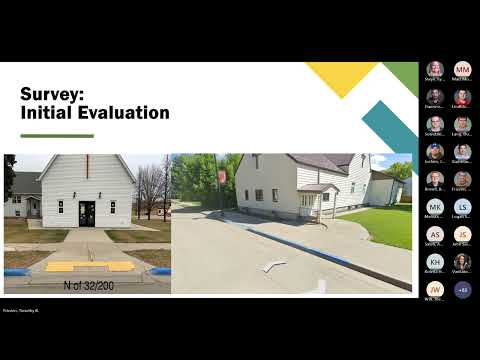
Field evaluation and survey: Presenters recommended using a total station for vertical accuracy rather than relying on GPS collectors. The DOT team said GPS vertical accuracy can vary and provide an incorrect cross slope; as Brandon put it, “the vertical accuracy of GPS is, you know, probably around 5 hundredths,” which can change a measured 2% slope into an out-of-compliance value. They described practical steps: measure several points with a smart level, check 48‑inch minimum clearances, inspect for vertical changes in level (1/4‑inch max without bevel; up to 1/2‑inch allowed if beveled), and verify grade breaks are perpendicular to direction of travel.
Design guidance and standards: The presenters walked through the DOT’s standard curb-ramp types (preferred type 1; type 4 least preferred), recommended design slopes (aim between roughly 5% and 7% rather than the 8.3% maximum), and suggested leaving design cross slopes slightly below the 2% limit so future heave or settlement is less likely to push the ramp out of compliance. They also described use of a “maximum extent feasible” technical memorandum when site geometry or private property constraints make full compliance impossible, and said the memorandum is signed by tech support and design division to document the agreed approach.
Right-of-way and curb-ramp agreements: Mary Falsing of the DOT right-of-way division described a voluntary curb-ramp agreement that the department uses when work requires temporary access to private property. The form is intended for light construction tasks (set/remove forms, restore vegetation) and is not recorded. Mary said the agreement includes an owner checkbox granting or denying permission to enter the property and a required one-time minimum payment: “It’s a 1 time minimum payment of $300 per property owner.” She emphasized the voluntary nature of the program: “Curb ramps are voluntary. We will not condemn on them.” The DOT will not perform a ramp where the property owner declines access via that form.
Plans, notes and construction inspection: Inspectors (Ethan and Mark) discussed construction verification and contractor responsibilities. Mark emphasized traffic-control and order-of-operations rules (landings and curb first; ramps, transition panels and detectable warnings last) and warned that survey stakes will be disturbed and must be monitored in the field. Construction notes included a plan-note reminder that “any ramp found to be in noncompliance will be removed and replaced by the contractor, their own expense.” The DOT also prefers reinforcing steel in curb ramps to reduce cracking and faulting from snow‑removal equipment.
Procurement/plan timing and coordination: Presenters noted schedule and coordination constraints: AD plans for a job were due in June, but right-of-way limits needed to be known by January so right-of-way acquisition and other reviews can proceed. They advised teams to start ADA survey and design early so historical, railroad, and right-of-way reviews have time to complete their work.
What was not decided: no formal actions or votes were taken during the webinar; the session provided technical guidance and a template process rather than board-level policy changes.
The DOT presenters encouraged teams to coordinate early with right-of-way staff, design division and the construction inspectors to minimize rework in the field.