Lifetime Citizen Portal Access — AI Briefings, Alerts & Unlimited Follows
N.D. DOT trainers review pavement‑marking standards, inspection practices
Loading...
Summary
North Dakota Department of Transportation staff reviewed MUTCD updates, material acceptance, grooving and inspection practices during a training session, emphasizing safety, calibration of data‑logging systems and new limits on obliteration of markings.
Lyle, ND DOT staff, led a training session on pavement‑marking standards and inspection practices for maintenance and construction personnel on Oct. 11, 2025.
The session explained which national and state references inspectors should use — including the Manual on Uniform Traffic Control Devices (MUTCD), the agency design manual, traffic operations manual, standard drawings and the department’s specifications — and why those references matter for consistency, safety and future machine‑vision detection of markings.
Inspectors were told to verify that materials are listed and certified by the department’s Materials and Research unit before use and that acceptance occurs by certification, testing or field acceptance depending on product type. Lyle said water‑based paint, epoxy, methyl methacrylate, preformed tape and thermoplastic each have distinct application and acceptance requirements; epoxy, for example, requires a thicker application (20 mils) and a higher glass‑bead rate (about 25 pounds per gallon) than water‑based paint (16 mils; about 6 pounds per gallon).
The training stressed field practices for grooving and preformed tape: grooves must follow the message shape (not be simple rectangles), meet depth/width tolerances, be cleaned of dust and, if grooves are not filled within about 20–24 hours, must be sandblasted and completed the same day the groove was prepared. Lyle advised inspectors to confirm groove alignment and to ensure contractors do not leave unfilled grooves overnight.
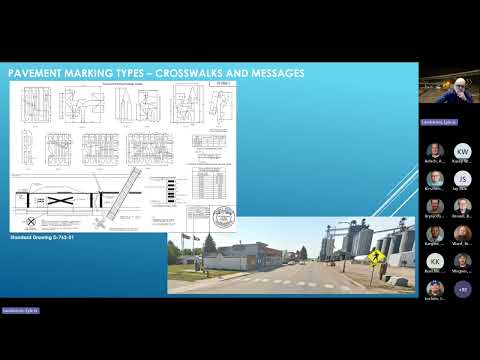
The session also covered dimensional guidance and safety rationale: the department has adopted 6‑inch lane lines and 12‑inch channelization lines on roads with speeds greater than 40 mph; Lyle said, “60 percent of fatal accidents are lane departures, so it’s a good idea anyways.” Inspectors were reminded to follow standard drawings for crosswalk layout (D76201) and to check maintenance agreements for rural crosswalk responsibility before ordering re‑striping.
Speakers described temperature and surface requirements for materials (paint typically requires surface and air temps above 45°F; epoxy typically above 54°F, with contractor submission and manufacturer approval needed for placement at lower temps) and the need to calibrate data‑logging systems (DLS) by measuring a 100‑foot section to ensure actual application rates match recorded rates.
The training highlighted changes in the 2023, 11th edition MUTCD: “obliteration of pavement marking — painting over existing pavement markings with black paint or spraying with asphalt — shall not be accepted as a substitute for removal or obliteration,” and the chapter reorganization now includes guidance tied to autonomous vehicle detection of edge lines. Trainers recommended removal methods such as sandblasting, shot blasting or water blasting (with caution for freezing conditions) and warned that grooves can leave long‑term traces if over‑grooved.
Lyle concluded by urging inspectors and designers to coordinate on adjacent projects so contractors do not introduce a patchwork of differing materials and to read special provisions for atypical materials such as methyl methacrylate or polyurea.