Get Full Government Meeting Transcripts, Videos, & Alerts Forever!
Get email alerts on the Transportation Federal Aid Lpa topic
No spam. Unsubscribe anytime.
Consultant urges LPAs to plan for higher costs, staffing and documentation on federal-aid projects
Summary
Jordan Ells, senior transportation group leader at Moore Engineering, told a North Dakota Department of Transportation district training that local public agencies should plan for higher upfront costs and more staffing when using federal-aid funds for roads and other projects.
Jordan Ells, senior transportation group leader at Moore Engineering, told a North Dakota Department of Transportation district training that local public agencies should plan for higher upfront costs and more staffing when using federal-aid funds for roads and other projects.
Ells said the most important step is setting expectations during project planning, not just at construction. "Following the Federal Highway and DOT requirements will cost money," he said, adding that the apparent 80/20 federal-to-local construction split can be offset by additional engineering and administrative costs needed to meet federal requirements.
Why it matters: Ells said failure to follow NDDOT and Federal Highway requirements can make bid items ineligible for reimbursement and shift large unbudgeted costs to LPAs. He used an example in which a paving item that would have cost $500,000 total — with a typical federal share of $400,000 and local share of $100,000 under an 80/20 split — could become entirely the LPA's responsibility if required QC/QA testing was not performed correctly.
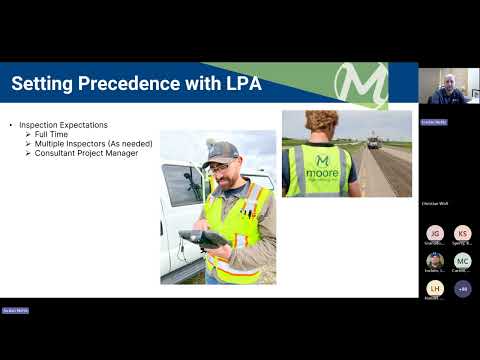
Ells outlined several specific requirements and pitfalls. He said LPA projects commonly require full-time inspectors, sometimes multiple inspectors for traffic control and material sampling; a consultant project manager on-site most of the time; and retention of records for three years after project completion. Ells also described the federal- and DOT-level roles: the NDDOT must provide an engineer in responsible charge, and the LPA must provide a full-time employee in responsible charge of the project. "Hired consultants cannot act in the role of an employee in responsible charge," he said.
On change orders, Ells summarized the Federal Highway definition: any alteration to the original construction contract including cost, schedule or specification changes. He advised documenting the justification, time and resources, negotiated scope and price, and whether the change is eligible for federal participation. He said if total federal funds are exhausted on a change, the owner becomes responsible for further costs and DOT review may no longer apply.
On materials testing, Ells recommended using the checklist the Bismarck District presented and said his firm is adopting a similar spreadsheet to prepare items before preconstruction. He described the three testing roles used on federal projects — QC (quality control) performed by the contractor, QA (quality assurance) typically performed by the LPA or its consultant, and IA (independent assurance) performed by the DOT materials coordinator — and warned against conflicts when the same testing firm does both QC and QA. "If it's not there, it didn't happen," he said, urging timely uploads of test results to the DOT materials system.
Ells also warned that violations of Buy America or NEPA approvals on one segment can jeopardize federal funding for a larger project covered under the same NEPA document. He described that outcome as potentially making an entire NEPA-covered corridor ineligible for federal funds if Buy America requirements are not met on a portion of the work.
Ells recommended early and frequent communication with the DOT district consultant oversight and the district materials coordinator, inviting them to preconstruction and regular meetings, and scheduling IA testing well ahead of time because materials staff have multiple projects to coordinate.
The presentation concluded without formal actions; the session will be uploaded to the DOT website in the coming weeks.