Get Full Government Meeting Transcripts, Videos, & Alerts Forever!
Get email alerts on the Transportation topic
No spam. Unsubscribe anytime.
NDDOT inspectors describe Valley City box culvert installation, agree to reroute water main over new structure
Summary
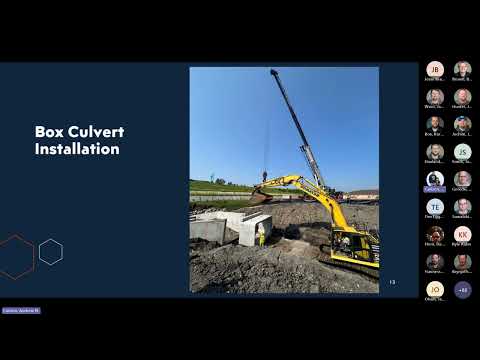
Andy, a project engineer with the North Dakota Department of Transportation, summarized construction and inspection work for a Valley City drainage-improvement project, including installation of a 1,703‑foot box culvert and a decision to reroute a new water main to run over the culvert.
Andy, a project engineer with the North Dakota Department of Transportation, on Thursday summarized construction and inspection work for a drainage-improvement project on Main Street in Valley City, including installation of a 1,703-foot box culvert and a rerouted water main.
The work included installation of 316 precast box sections (140 five-foot sections, 146 six-foot sections and 28 mitered sections), placement of a new water main, construction of an outlet structure, and reconstruction of the frontage road. "The contractor decided they thought they could do it all in 1 year, so we removed the pavement on all the frontage road in order to install the water main," Andy said.
The presentation detailed several inspection and field decisions. The plans originally showed the water main routed beneath the box culvert at roughly 18 feet below grade; the contractor proposed running the main over the box to avoid burying it 17–18 feet deep. "They came to the DOT and asked if they could reroute it, and we talked to the city and the designers, and they both agreed it'd probably be better to go over top than to bury it 17 feet underneath," Andy said. The reroute was implemented with insulation board under and over the pipe where it crossed the culvert.
Andy described unanticipated conditions and mitigation steps. During tie‑in to the existing system crew discovered an existing asbestos water pipe not shown on the plans; NDDOT engaged a consulting firm to inspect and recommend handling. The consultant cleared removal and disposal; the contractor wrapped cut sections, used PPE, and hauled material to Jamestown for disposal. Andy said crews used a water-sprayed saw during cutting to control dust.
Trench safety and dewatering proved central during installation. Andy said OSHA inspected the site while box installation was underway and ordered the contractor to address trench-safety issues before continuing. High groundwater and repeated rain events flooded excavations several times; crews used continuous pumps and later installed two sumps to collect and, with Department of Health approval, pump some water back to the stream. Andy reported the project collected about 30,000 gallons of water while the plans had accounted for 15,000 gallons of capacity in the treatment ponds; additional volumes were hauled off-site to Fargo when pond capacity was exceeded.
Excavation quantities exceeded plan estimates. Andy said the plans called for removal of 233 cubic yards of CommonX waste but crews removed just under 3,000 cubic yards; rock excavation totaled about 973 cubic yards. The contractor and NDDOT agreed a load-count payment method for CommonX waste after actual conditions proved far greater than plan quantities.
Inspection and quality-control steps included frequent compaction testing by Braun Intertech. Andy said the project used a nuclear gauge and reported the testing program helped the contractor proceed quickly. He also described post‑installation checks for spalls, alignment, and joint gaps; the plans specified a 3/4‑inch joint gap, and Andy said the largest observed gap was about a half inch.
Andy praised the contractor, Landwehr Construction of St. Cloud, Minnesota, for performance and noted schedule and staffing changes (new crane operator, project manager on-site) improved daily production from about 33 feet of culvert set per day early in the project to roughly 70 feet per day later. "Once you get off alignment, it's hard to correct it," he said, describing alignment as the project's primary technical challenge.
No formal policy or legislative action was taken during the presentation; Andy answered questions from meeting participants and closed the topic.