
Sioux City schools to refer unpaid meal accounts over $300 to collection agency after board vote
Get AI-powered insights, summaries, and transcripts
Subscribe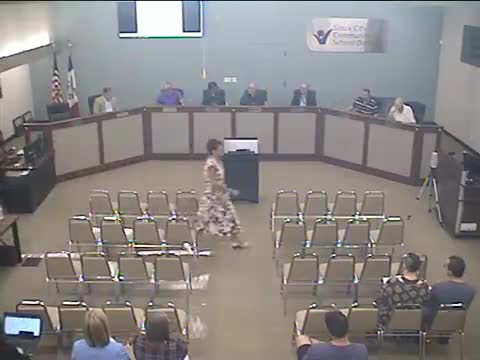
Summary
The Sioux City Community School District board approved a plan to refer unpaid student meal accounts of $300 or more to a collection agency after staff said unpaid balances rose sharply following pandemic-era universal free meals.
Sioux City — The Sioux City Community School District Board of Directors voted 5–2 on Aug. 25 to allow the district to pursue outside collections for unpaid student meal accounts of $300 or more after staff said unpaid balances have grown substantially since COVID-era universal free meals.
The board’s action followed a presentation from Angela Bemis, a district staff member, who described the district’s unpaid lunch balance proposal and said the district had exhausted its usual outreach efforts. “We always give students a lunch. So every student gets a lunch regardless if they have money or not,” Bemis said during the meeting.
Why it matters: District staff told the board the unpaid balances are large enough that the district’s nutrition program cannot sustainably carry them. If collections recover even a fraction of the debt, staff said it could reduce pressure on district accounts or the need to shift general-fund dollars to cover cafeteria shortfalls.
Staff briefing and context: Bemis told the board that for the three years during which lunches were free districtwide, unpaid balances accumulated and the district now carries semester balances that approach $80,000 to $90,000. She said that as of May 27 the district showed $79,628 in outstanding lunch debt and that 53 student accounts exceeded $300.
Bemis described multiple outreach steps the district already uses: weekly automated calls and mailed letters, extra staff hours for personal phone outreach, in‑building efforts by lunch staff and secretaries, and repeated offers to complete free-or-reduced-price (FRP) applications by phone or mail. She said the district will not identify or stigmatize students with unpaid balances and will continue to provide meals to all students.
Proposed collection process and safeguards: The board considered a staff recommendation to contract with NCS (a local collection firm staff had preliminarily reviewed) to pursue accounts over $300 after the district documents repeated outreach and offers of payment plans. Bemis said the firm “does not charge a fee; they just take a percentage of what they collect,” a preliminary figure staff said might be about 15 percent. Staff also said other districts report collection yields around 30 percent.
Board questions and fiscal options: Directors asked how the balances affect district finances and what alternatives exist. Directors were told donations and the district’s nonprofit foundation have helped clear balances in prior years but that foundation payments can perpetuate unpaid-balance behavior when payers expect a third party to absorb debt. The board was also told the district cannot simply “write off” meal debt within the nutrition fund; the district could, if it chose, transfer general-fund dollars to cover cafeteria shortfalls.
Director John Myers (board member) asked what a budgeted general-fund transfer would look like; staff estimated roughly $100,000 per year as a planning figure based on recent semesters’ experience. Director Myers said he was “not interested in raiding the general fund” for that purpose, an exchange that underlined the board’s concern about tradeoffs.
Vote and motion: A motion to approve using a collection agency for qualifying accounts passed by roll call: Directors Emke, George, Greenwell, Myers and Michaelson voted yes; President Lee and Director Miller voted no. The motion text approved was to utilize NCS for unpaid lunch balances of $300 or more where the district has documented outreach and offered payment options prior to referral to collections.
What the board did and did not do: The approved procedure requires documented attempts at outreach and an offer of a payment plan before referral. The board did not approve punitive measures such as denying meals; staff repeatedly said the district will continue to provide meals to students regardless of account status. The board also did not adopt a specific contract with NCS at the meeting; staff said a contract would be negotiated and brought back.
Remaining questions and cautions: Directors and staff noted uncertainty about likely net recovery after collection fees and the risk of community backlash. Director Miller asked whether NCS had a track record in school-lunch collections; Bemis said NCS had not done lunch collections locally and that district peers report widely varying recovery rates. Director Reed asked whether the district had asked the school foundation to expand its fundraising role; staff said the foundation has been paying balances in prior years but that those payments had not reduced recurring overall debt.
Next steps: Staff will negotiate the proposed contract language with a collection vendor and return to the board with contract details and documentation requirements for referrals. The board’s approval authorizes the district to pursue the collection strategy for accounts meeting the $300 threshold after required outreach is documented.
Ending: The discussion closed with board members emphasizing both the district’s intent not to penalize students and the need to address a growing fiscal problem. A final contract and procedural language are expected to return to the board for approval before referrals begin.