
Sioux City board presses staff for pay-and-recruiting plan after lengthy special‑education para discussion
Get AI-powered insights, summaries, and transcripts
Subscribe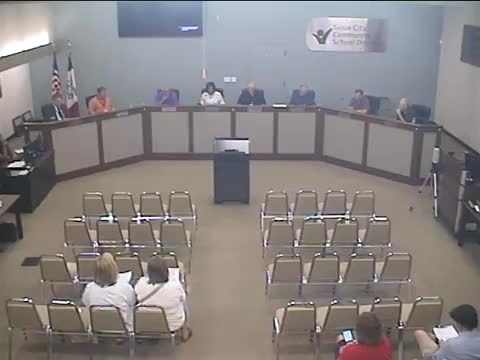
Summary
Board members spent more than an hour on Aug. 11 discussing pay and staffing for paraprofessionals who support students with intensive special‑education needs, heard that 41 para positions are currently open and asked staff to return with a costed proposal and a bargaining approach.
Sioux City Community School District board members on Aug. 11 heard an extended presentation and debate about pay, recruitment and retention for paraprofessionals who support students with intensive special‑education needs and directed staff to return with a formal proposal and bargaining approach.
The board’s discussion followed a human resources presentation that said the district has added about 100 paraprofessional positions in the past two years and that about 41 positions are currently open, most in special education. Angela Bemis, staff member (human resources), told the board the district is relying on four types of programs — Compass Academy, Verbal Behavior Classroom (VBC), autism supports (ASD) and Foundations — and that roughly 80% of instructional aides work in those programs, “so about 300” positions in total are tied to that set of classrooms.
Why it matters: School leaders said unfilled paraprofessional posts are hurting daily instruction for students with high needs and increasing the workload for teachers. Board members framed the issue as both a student‑support and a workforce problem: private providers in the community are offering substantially higher hourly pay, year‑round work and benefits, and the district is losing applicants and recent hires to those employers.
Most important facts: Bemis said paraprofessionals in the four intensive programs currently receive an extra $1.10 per hour above base pay; the overall hourly range for paraprofessionals with that stipend is “right around” $16.50 to about $20 depending on experience. Board members said private providers are paying about $25.75 an hour and often offer tuition assistance, paid time off and year‑round employment; those private jobs generally do not provide IPERS retirement participation.
On funding and scale, district staff told the board that special education spending authority from the state allows the district to budget for additional special education positions but does not provide immediate cash, and that the district expects to spend several million dollars more than projected revenue this year on special education. In the discussion staff and board members used the district’s internal estimates to illustrate scale: leaving current openings unfilled produces roughly $1.2 million in short‑term savings; not filling certain teacher positions would raise that to about $3.2 million; combined, those unfilled positions represented approximately $4.5 million in savings on the back of the envelope described in the meeting. Board members noted those accounting figures do not remove the operational problem — students’ needs remain unmet if positions are unfilled.
Discussion and disagreement: Several board members pressed for urgency. Director Michaelson said, “They need to see the same person every day,” referring to students’ need for consistency. Director Miller asked for a clear next step: “Is the next step that you’re gonna bring a plan to us that’s got the dollars, that has the recruiting plan?” Bemis and other staff said they already have a recruiting and retention plan that includes job fairs, expanded onboarding and additional training days for special‑education assistants and that they have begun to pay 100% of the premium for the district’s lowest health plan for paraprofessionals in order to reduce benefit‑related pay erosion.
Collective bargaining and timing: Board members and staff repeatedly raised the district’s collective bargaining obligations. Director Amke (board member) reminded the group that paraprofessionals are covered by the district’s collective bargaining agreement. Bemis said the district has spoken with association leadership and that a memorandum of understanding (MOU) or bargaining approach would be required to implement any pay change outside of full contract negotiations. Some board members urged the board to signal support for an interim solution before the start of the school year because of the urgency to get pay in place before the first payroll; others cautioned that unilateral action without an agreed MOU could complicate bargaining later.
Direction from the board: Without taking a formal vote to change pay that night, the board asked staff to return at the next board meeting with a detailed proposal including cost estimates, a recruiting plan, and options for an MOU or bargaining timeline so the board can consider formal approval. Bemis said staff would present figures and options for prioritizing the highest‑need classrooms first.
Context and background: Staff said the district created the Verbal Behavior Classroom two years ago in response to rising kindergarten through second‑grade behavioral and communication needs; those classrooms often operate with a 1:1 adult‑to‑student ratio. The district also described an increase in students eligible for “foundations” or intensive self‑contained programs, which has driven the need for more paraprofessionals. Board members referenced a prior mid‑year market adjustment three years ago and said market pressures have intensified since private providers expanded local offerings.
What’s next: Staff will return with a costed proposal and suggested MOU/bargaining approach at the next board meeting. The board did not adopt a pay change at the Aug. 11 meeting.
Ending details: The discussion included repeated references to the operational impact on classroom teachers and non‑special‑education students when aides are not present. Board members emphasized the urgency and broadly signaled support for a solution while acknowledging the legal and budgetary constraints of collective bargaining and district finances.