
Canyon ISD trustees approve teacher, principal and staff pay increases after budget workshop; district warns of multi‑year deficit
Get AI-powered insights, summaries, and transcripts
Subscribe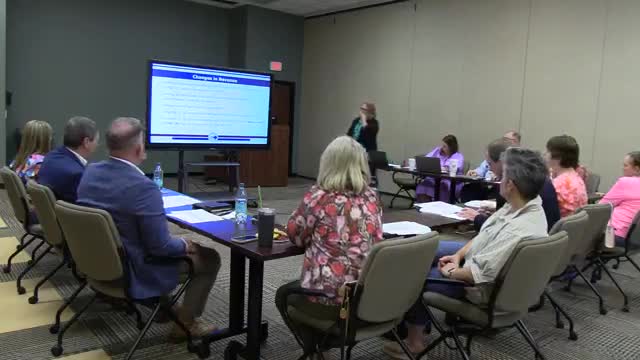
Summary
After a two‑part budget workshop, the Canyon ISD Board of Trustees approved salary steps and across‑the‑board increases while staff warned the district faces a multi‑year deficit that will draw down fund balance unless revenues change.
CANYON, Texas — The Canyon ISD Board of Trustees on July 14 approved recommended salary increases for teachers, principals and other staff after a budget workshop that reviewed revenue projections, state funding changes and multi‑year deficit scenarios.
The trustees voted unanimously to adopt the administration’s proposal: a flat $5,000 step increase for teachers on step 5 and above, a $5,000 flat increase for principals (including associate and assistant principals), and a 2% increase for other staff calculated from each position’s midpoint. The board also approved a 10¢ increase in student meal prices, a quarterly investment report and several related budget items during the meeting.
The decision follows a detailed presentation by district finance staff about how state changes and local tax compressions affect Canyon ISD’s revenue. Leila, a district finance staff member who led the budget briefing, told trustees the district’s audited fund balance as of Aug. 31, 2024, was $50,756,024. She said the district’s required minimum reserve (20% of operating expenses) is about $23,000,000, leaving padding of roughly $27,756,000. Under a worst‑case scenario already presented in a June workshop, the district faces an approximately $10,000,000 deficit in 2025–26, which would cut available reserves sharply.
“If you take that padding amount of $27,756,000 and you minus the $24,256,000 deficit, that calculates out to a padding left of only $21,000,756,” Leila said during the workshop. She warned trustees that continued deficits at the projected levels would leave only a small cushion by 2027.
Why it matters: Canyon ISD’s payroll is the district’s largest expense. The board’s salary decisions respond to state requirements and the teacher retention allocation in House Bill 2, which includes fixed allotments for classroom teachers. District staff said the HB2 retention allocation includes $2,500 for teachers on certain steps and $5,000 for higher‑step teachers; the state also provided an estimated $45 per ADA (average daily attendance) for instructional support. Trustees said preserving teacher pay competitiveness is a priority despite tight finances.
Details from the workshop and board action: - Revenue outlook: Staff walked trustees through the district’s revenue sources — state funds tied to attendance and enrollment, and local property tax revenue. Presenters noted that compressed local tax rates reduce the portion of property tax that can be used for maintenance and operations and that state recapture can reduce local revenue when valuations generate excess state‑calculated revenue. - HB2 implications: Finance staff estimated the retention allocation and related employer costs would obligate the district to roughly $4.246 million in direct salary commitments, before other payroll decisions are layered in. - Fund balance math: Audited fund balance (Aug. 31, 2024) $50,756,024; required 20% cushion ≈ $23,000,000; padding ≈ $27,756,024. Under the workshop’s worst‑case for 2025–26 (≈ $10,000,000 deficit), the padding would shrink materially, leaving limited reserves for 2027. - Salary options modeled: Staff showed multiple “plug‑and‑play” scenarios. The adopted option combined the HB2 required teacher allotments, a $5,000 flat increase for principals and teachers on higher steps, and a 2% increase for other staff (midpoint basis); trustees were shown how other permutations (for example, a 1.5% across‑the‑board or different mixes of step/top‑ups) would change the district deficit.
Trustee discussion focused on tradeoffs between maximizing teacher and staff compensation and preserving a sustainable fund balance. Several trustees said they wanted the district to protect jobs and remain competitive for hiring while recognizing the district would need a multi‑year plan to close structural deficits.
Votes at a glance (board actions taken during or immediately after the workshop): - Approve salary increases as presented (administration recommendation). Motion by Jenny; second by Mandy. Outcome: approved (unanimous). Notes: the approved package is the payroll option presented by finance staff combining HB2 obligations with the local raises described above. - Approve food service price increase of 10¢ across meal types. Motion by Casey; second by Randy. Outcome: approved (unanimous). Rationale: rising food costs and equipment replacement needs in school cafeterias. - Approve the district professional development plan for 2025–26 (see separate article on curriculum/professional development). Motion by Lori; second by Randy. Outcome: approved (unanimous). - Approve quarterly investment report (quarter ending 05/31/2025). Motion by Casey; second by Randy. Outcome: approved (unanimous). - Authorize membership in Region 19 cooperative purchasing interlocal (to access vendor contracts, including software procurement). Motion by Mandy; second by Lori. Outcome: approved (unanimous).
Staff and board said the district will return with a budget amendment for formal adoption later in August (or at a special meeting if needed) to finalize line‑item changes tied to the voted compensation package and other adjustments. Leila told trustees she would prepare that amendment and confirmed that June and July transactions are not yet reflected in the May 31 financial snapshot used for the workshop.
District next steps and outstanding issues: Trustees asked staff to continue to refine projections (including finalized certified property values) and to present options for revenue increases or further expense reductions if reserve erosion continues. Staff also flagged that some employer costs (the district’s share of benefits tied to increased salary) will increase total obligations beyond the straight salary figures and that timing of state payments tied to HB2 means some receipts will not fully align with payroll cashflow this fiscal year.
The board meeting and workshop lasted into the evening. The district will reconvene budget work in August when property‑value certification and final state revenue calculations are available.