
Harnamapapa Schools board adopts handbook changes to align with recent state laws
Get AI-powered insights, summaries, and transcripts
Subscribe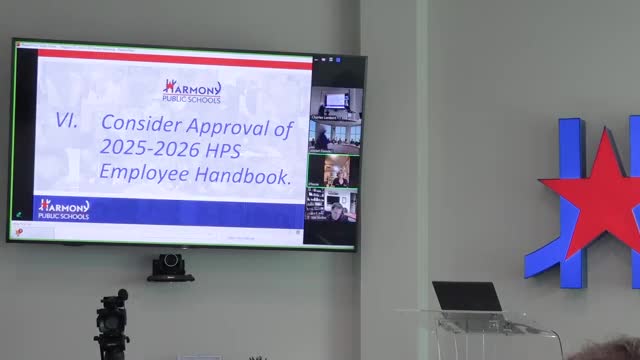
Summary
At its Aug. 23 meeting the Harnamapapa Schools board voted to adopt a package of employee handbook and board-policy updates meant to implement recent state legislation on employee religious expression, background checks and reporting, parental engagement and restrictions on DEI duties.
Harnamapapa Schools’ board voted Aug. 23 to adopt a set of revised board policies and handbook changes that staff said implement recent state laws affecting employee conduct, background checks and parental engagement.
The changes, presented by human-resources staff and legal counsel, update pay and benefits administration, define “first‑year” employees and unpaid leave, tighten background‑check and registry reporting requirements for employees and contractors, and add provisions required by multiple newly passed state bills on employee religious expression, certification revocation and limits on diversity, equity and inclusion duties.
Board members were told the handbook updates include a new standard requiring employees to provide direct‑deposit information (with limited one‑time exceptions), expanded benefits detail and clarified leave rules for first‑year employees. HR staff said the policy now defines a first‑year employee as someone in their first 12 months of employment or a retired individual rehired after a gap of 12 months; first‑year employees who do not qualify for FMLA will be entitled to up to six weeks of unpaid, job‑protected leave for medically qualifying reasons. The package also clarifies combined leave when two spouses are both in their first year of employment: staff said two spouses employed in their first year would be entitled to a combined six work weeks of unpaid leave to care for a newborn or newly placed adopted child, and in some circumstances a combined 12 work weeks when one spouse is eligible for FMLA and the other is still within the first 12 months.
Legal counsel described several statutory changes staff implemented into policy. Staff said the district must now remove and place on administrative leave any employee whose certification is revoked pending investigation. The board heard that misconduct definitions have been expanded to include abuse or physical mistreatment of a student or minor, solicitation of a romantic relationship with a student, inappropriate communications or breaches of professional boundaries; termination for any such misconduct must be reported to the state education agency (TEA) and to parents or guardians, staff said. The required timeline to report misconduct to TEA was shortened, in staff’s presentation, from seven days to 48 hours; the timeline to report to child protective services and law enforcement was shortened to 24 hours, staff said.
Staff also described statutory tightening of pre‑employment and registry requirements. Presenters said contract workers, subcontractors, volunteers and vendors who may have contact with students must meet the same background and “do not hire” registry checks as employees; contracting entities must certify they have performed required criminal history checks for their workers. Staff said this closes gaps that previously allowed some individuals to move between districts without discovery of prior employment or conduct concerns.
The packet presented to the board also implements provisions from a bill staff identified as prohibiting assignment of DEI duties in public education except where necessary to comply with state or federal anti‑discrimination law. Staff summarized the changes as a restriction on assigning personnel or district resources solely to diversity, equity and inclusion duties; it also places new limits on classroom activities and course credit tied to political or social advocacy, subject to statutory exceptions for required curriculum and certain state or federal observances.
On parental engagement, staff said the law requires a parent portal and easier means for parents to contact teachers, administrators and board members; staff said the district already maintains an online portal and would add structured routing for parent communications to comply with the new rules. Staff also said charter schools must now establish a student health advisory council that includes parents and community members to advise on health curriculum and related policies.
Board members asked for a clear, page‑by‑page summary of what changed in the handbook for distribution to staff. Staff said they would bring a larger package of updates at the next meeting but that the changes before the board were “pressing” and required adoption before Sept. 1. After discussion, a board member moved to approve the adoption of the new and revised HPS board policies as presented; another board member seconded. The board recorded vocal “ayes” and the chair announced the policies approved.
The board-approved packet, staff said, also reflects several administrative cleanups: removal of a rarely used “end of summer” extension of leave, elimination of a “summer exit week” provision, and revised language on reporting work‑related injuries (staff said the district will pay for worker‑comp medical appointments required during the workday when those appointments are required by the carrier). Staff characterized the unacceptable‑conduct additions as largely drawn from counsel’s review and from recent Senate bills.
Board members and staff agreed to review more detailed implementation procedures during the board retreat and to circulate a clear summary of changes to staff ahead of school start.