
Canyon ISD reviews proposed student code updates tied to new state laws; board asks for more time
Get AI-powered insights, summaries, and transcripts
Subscribe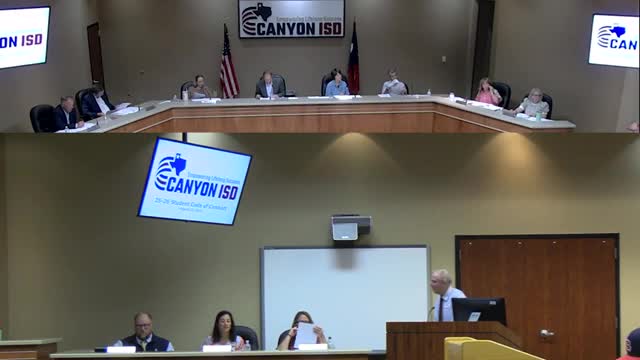
Summary
Board heard extensive presentation on student code of conduct updates required by several state bills (House Bill 6, HB1481, SB326, SB569); trustees asked for additional review time and staff offered follow-up.
Canyon ISD trustees reviewed a set of proposed revisions to the district’s student code of conduct on Aug. 25 that administrators say are needed to align local discipline procedures with recent state legislation, including House Bill 6, House Bill 1481, Senate Bill 326 and Senate Bill 569.
The presentation covered multiple items that administrators said the law now requires or clarifies: a campus behavior coordinator role to monitor disciplinary referrals (a change tied to HB6), inclusion of the state’s definitional language for antisemitism (cited to government code section 448.001 and SB326) so administrators have clearer guidance when determining the nature of incidents, adding personal-communication-device rules to the code (HB1481), and new options for virtual education as an alternative in expulsion-related cases (SB569).
Administrators described how the campus behavior coordinator will coordinate referrals and work with campus threat and safety teams, and they said the district’s disciplinary intervention guide and administrative regulations will provide the operational steps implementing the code. On vaping and disciplinary placements, staff said the district will continue to use a discretionary DAP placement rather than a mandatory DAP because administrators judged it preferable to 10 days of ISS in many cases.
Board members asked procedural and substantive questions about several items: who composes placement-review committees, how return-to-class plans will be documented, parental options tied to alternate assignments for OSS and how virtual options might be used as an alternative to expulsion. Trustees also requested clearer language and time to review the recommended local-policy text, especially on library and reconsideration committee procedures. At one point a trustee asked whether the vote to adopt the code could be delayed; staff said the district’s current code remains in effect until replaced but agreed to provide additional clarifications and to return with recommended wording changes.
What the board did: at the meeting trustees did not adopt a final code text; they directed staff to research and refine language on several items (including return-to-class language and library-materials/reconsideration procedures) and to return with updates for future consideration.
Why it matters: the code contains legally significant changes that affect student discipline, grievance/reconsideration procedures, required campus roles and administrators’ decision-making tools for issues such as antisemitic incidents and expulsions. Trustees emphasized consistency with the law while also seeking clarity and flexibility for campus administrators and parents.
Next steps: administrators will incorporate trustee feedback into the local-policy draft and administrative regulations, circulate alternatives, and bring revised text to the board for formal consideration at a future meeting.