
Round Rock ISD board approves 2025–26 student code of conduct, new phone and discipline rules after busy legislative session
Get AI-powered insights, summaries, and transcripts
Subscribe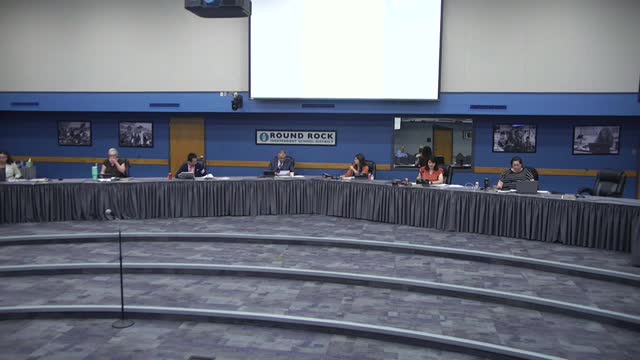
Summary
Facing a wave of new state laws, the Round Rock Independent School District board approved a revised student code of conduct and several policy updates that implement changes on cellphones, mandatory reporting, discipline, library procedures and parental-consent requirements. Administrators said they will publish procedures and train staff.
Round Rock Independent School District trustees on Aug. 14 approved a rewritten student code of conduct for the 2025–26 school year and adopted several local-policy changes to implement new state laws affecting student discipline, personal communication devices and parental notices.
The board unanimously approved the student code of conduct and related local policies governing extracurricular eligibility and personal communication devices; administration said the votes were 6–0 for those items and that the administration will publish updated procedures and training materials for campuses and families.
Administrators and legal counsel told the board the 2025 Texas legislative session produced dozens of education-related bills and a set of immediate requirements trustees needed to address. "The bill is very, very clear. It requires the board to adopt a policy prohibiting student use of cell phones, watches, smartwatches, other personal communication devices," Cindy, an administration policy lead, said while summarizing House Bill 1481. The district's local policy (FNCE local) implements that mandate by prohibiting device use on campus during the school day and authorizing staff to confiscate devices under defined circumstances.
District staff said they will hold devices securely, try to return property to families, and discard unclaimed items only after repeated efforts to reunite devices with owners. Administrators emphasized that exceptions will be made for documented medical needs or Individualized Education Programs (IEPs). "We hold items as long as possible," the assistant superintendent for student support services said when describing the district’s intended storage and return procedures.
The board also discussed changes to student discipline under House Bill 6. Administrators said the amended law gives districts discretion when a student is found with vaping devices: the district may place the student in a DAEP placement or suspend them for up to 10 days in or out of school. "The prior law mandated DAEP; the amended law gives districts the choice to either send them to DAEP or suspend that student for 10 days," Cindy told trustees.
Administrators outlined other legislative changes reflected in the handbook and code of conduct: - Mandatory-reporting timelines for suspected child abuse were shortened: campus mandatory reporters must now report within 24 hours, principals must notify superintendents within 48 hours of awareness of misconduct, and superintendents must report to the State Board for Educator Certification (SBEC) within 48 hours, administrators said. Legal counsel noted the legislature also expanded liability: House Bill 4623 creates a narrow waiver to district immunity in cases of gross negligence, recklessness or intentional misconduct tied to failure to report or other covered conduct and can expose districts to claims up to $500,000 per occurrence. - Senate Bill 12 requires parental notice and, in some cases, consent before health screenings or access to certain health records; it also restricts district-sponsored programs related to diversity, equity and inclusion and bars assistance with social transitioning. Administrators said guidance from TEA and TASB is expected and that compliance certifications to the state will follow a statutory schedule. - Senate Bill 13 (library materials) changes and school-library advisory councils ("slack") requirements were summarized; the board adopted the separate EFB local policy to implement those parts of the law. - Religious-instruction and prayer items (SB10, SB11, SB1049) were noted; SB1049 requires a local policy for excused absences for religious instruction by Jan. 1, 2026, and SB11 requires a recorded board vote by March 1, 2026 if the board chooses to designate time for student prayer or religious reading.
Administration said it had reviewed the code of conduct and handbook line-by-line with legal services, counseling, health services and other departments and incorporated new statutory duties and procedural changes. Dr. Natalie Nichols, senior chief of schools and innovation, said the district prioritized training for principals, counselors and campus leaders so implementation can begin immediately. "We worked with our legal department to identify those student- and family-facing impacts," Nichols said. "We also reached out to our department leaders... and just really page by page walked through our code of conduct and our handbook."
Board members asked for clearer parent-facing summaries and a communications plan. Trustees were told the administration will distribute parent-facing materials (FAQs and sections with page references) and work with principals to send targeted notices so families are aware of changes such as the cellphone-storage rules, health-consent notices and updated grievance procedures.
Administrators outlined a timeline: the district will bring additional local-policy updates in November for first reading and seek final adoption in December, and CASB/TASB model updates expected by October will be incorporated into a comprehensive 01/1926 update.
Ending: Trustees approved the student code of conduct and the associated local policies; administration will publish procedures and training materials and report back to the board on implementation.