
Alief ISD adopts 2025–26 student code of conduct with new disciplinary tiers and vaping penalty
Get AI-powered insights, summaries, and transcripts
Subscribe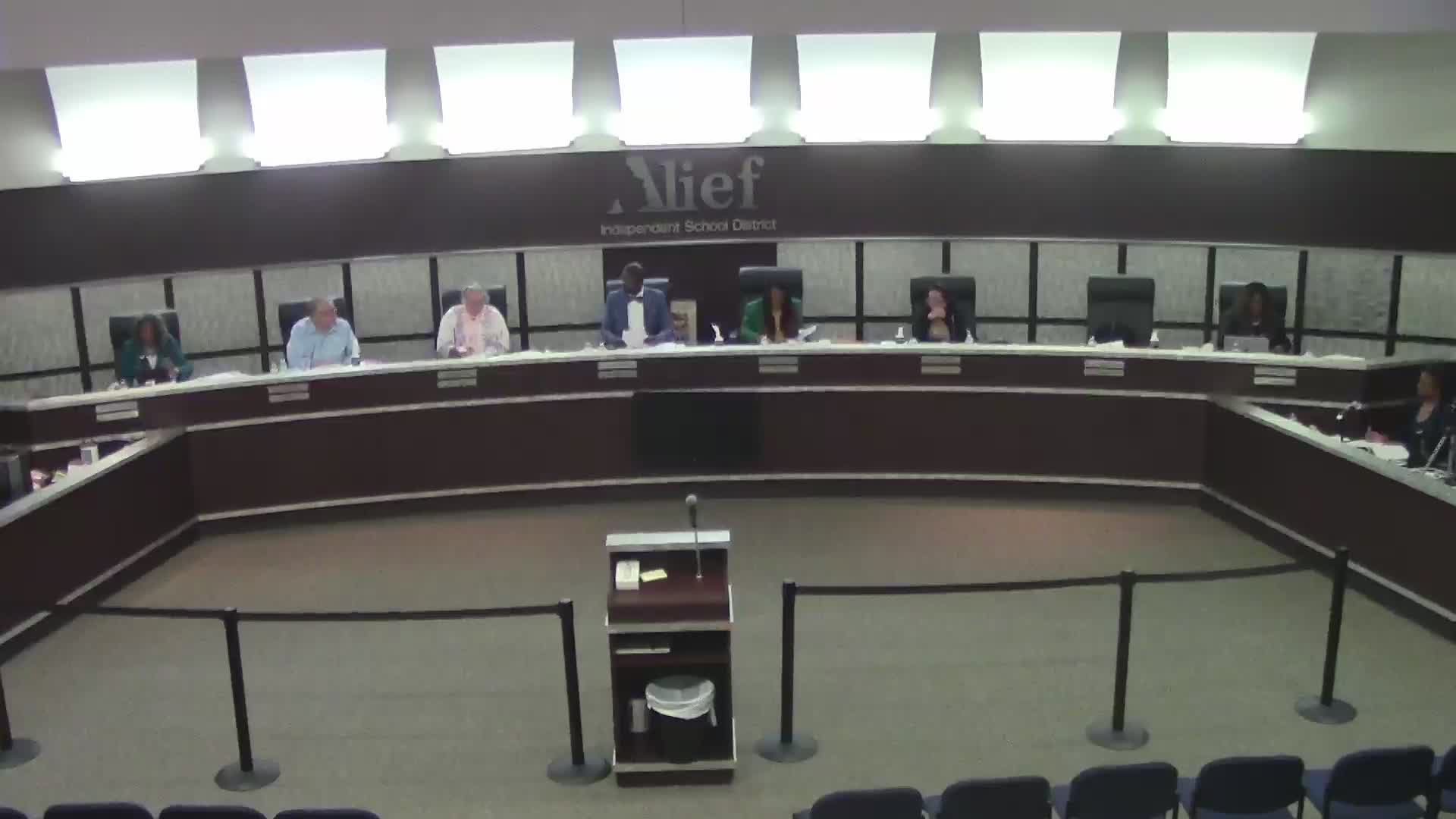
Summary
Trustees of the Alief Independent School District on Tuesday approved the district's 2025'26 student code of conduct, adopting changes administrators said were required by state law and reflecting new disciplinary categories for certain offenses.
Trustees of the Alief Independent School District on Tuesday approved the district's 2025'26 student code of conduct, adopting changes administrators said were required by state law and reflecting new disciplinary categories for certain offenses.
The board voted 6'0for, 0'against to approve the document after a presentation from Janine Porter, the district's chief of staff, and Mindy Robertson, director of student management services, who outlined additions and new consequence ranges meant to bring the handbook into compliance with recent state requirements (House Bill 6) and to address recurring student conduct issues.
Administrators said the most significant structural change is a new Level 4 category for serious or repeat offenses. Mindy Robertson said Level 4 includes items that can require removal to a disciplinary alternative education program; the presentation singled out repeat vaping and possession of vaping devices as a Level 4 offense that will trigger mandatory placement in the district's alternative program when the offense is coded at that level. Robertson described a scaled set of consequences that allows district staff to impose progressive discipline (short-term removal, longer short-term removals and, at higher levels, suspension or DAEP) depending on the offense and context.
Why this matters: trustees and staff said the revisions are intended to keep campuses safe while aligning district practice with state law. Trustee concerns ranged from how parents receive and acknowledge the handbook to whether graduation regalia and cultural stoles are permitted under district rules.
Key facts and actions - The board approved the 2025'26 Student Code of Conduct as presented. Motion: moved by Trustee Lily Truong; seconded by Trustee Janet Spurlock; vote tally: yes 6, no 0, abstain 0; outcome: approved. - Administrators said most redlined changes were driven by House Bill 6 and by operational needs (for example, adding a discrete code for repeat vaping so the district can report and place repeat offenders appropriately in DAEP). - The handbook now names "personal wireless communication devices" as an offense category on the PreK'2 continuum and adds revised consequence ranges across grade spans; administrators said the new Level 4 column was inserted to capture suspendable and expellable offenses.
Discussion and directions from trustees - Graduation regalia and cultural stoles: Trustee Rick Moreno asked administrators to study graduation dress restrictions, specifically whether students may wear country stoles (for example, Honduran, Guatemalan, Salvadoran stoles) and whether cap rules exclude students with certain hairstyles. Moreno asked administration to bring the issue back for board workshop discussion so trustees could consider whether the district's graduation attire rules should be revisited. - Parent acknowledgement and access: Trustee Anne Williams pressed for clearer, easier access to the handbook and confirmation of how parents acknowledge receipt. Administrators said the handbook is posted online, campuses handle hard-copy requests and that the district will deliver the handbook through ParentSquare and add a prominent website button to improve discoverability. Porter said campuses collect signed acknowledgements locally; Robertson said the district can work with campuses to measure return rates and improve the process. - Prevention and intervention for vaping: Trustees asked about supports for students who vape. Robertson and Dr. Mays (superintendent) said the district offers an online education module as part of DAEP exit requirements and that campuses also provide school-based prevention programming via MTSS/SAT supports. Administrators said the online education modules have been part of the response for multiple years.
Clarifying details - Legal driver: trustees and staff repeatedly cited House Bill 6 as the reason many of the redline changes were required. - DAEP reference: the district's alternative placement is referred to in the presentation as ALC/DAEP (Disciplinary Alternative Education Program); administrators said mandatory DAEP placement is required for certain repeat vaping offenses under the revised coding. - Process for parental acknowledgment: administrators said the handbook is posted online; campuses collect signed acknowledgements and the district will distribute the handbook via ParentSquare and add a direct web link.
What was not decided - Trustees asked administration to return with a separate discussion or workshop on graduation attire and cap/stole rules; no policy or rule change on graduation regalia was adopted at this meeting.
Ending The approved code takes effect for the 2025'26 school year; administrators said they will follow up with campuses to implement training for staff and to make the handbook easier for families to find and acknowledge.