
Plano ISD reports 2,600-student year-over-year enrollment drop; district outlines recovery and attendance efforts
Get AI-powered insights, summaries, and transcripts
Subscribe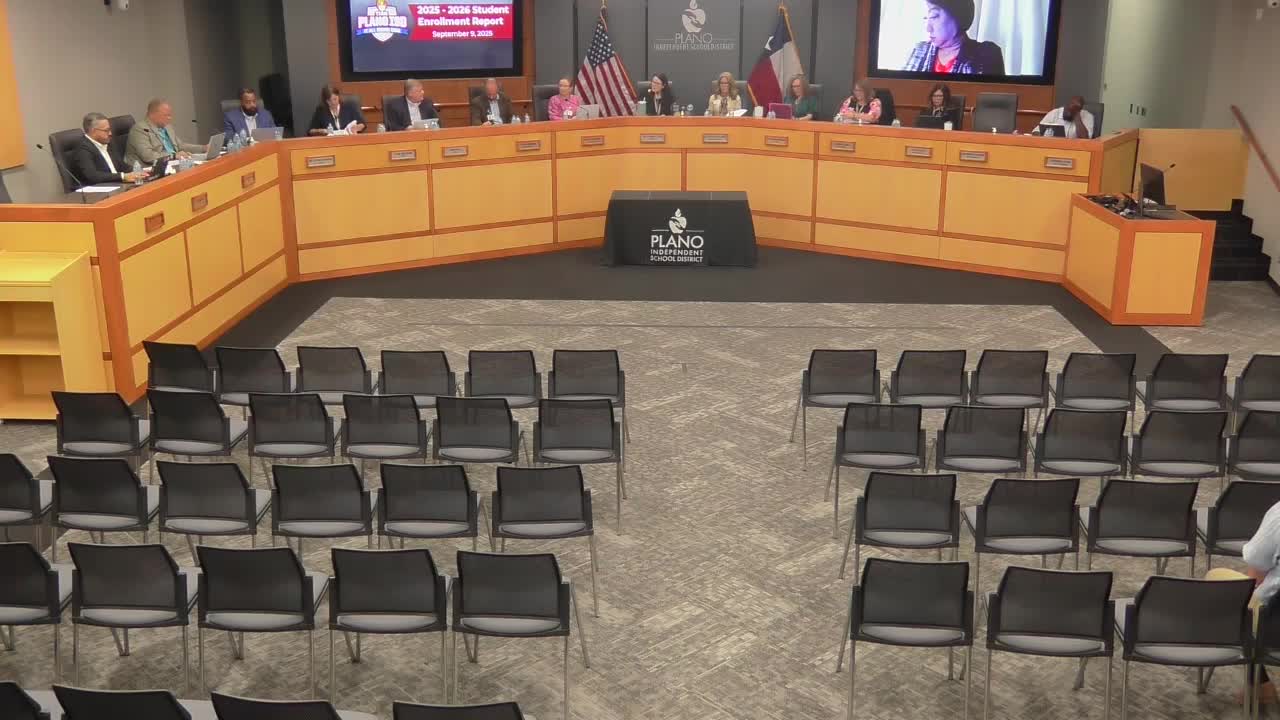
Summary
Plano ISD officials told the board the district—s fall snapshot showed about 43,905 students, down roughly 2,646 from last year, and described efforts to locate no-show students, reconcile enrollment codes and boost attendance.
Plano Independent School District—s leadership told trustees on Sept. 9 that the district—s early fall snapshot showed 43,905 qualifying students, a decline of about 2,646 students from last year, and outlined a multi-pronged effort to find students who did not return and to improve attendance. Johnny Hill, deputy superintendent for business, employee services and technology, said the district bases its yearly snapshots on the last Friday in October, but the board—s staff ran a preliminary check the first week of September and recorded "about 43,905" students. Hill said the district built its budget on a projected enrollment of 45,674 students and that the difference from that projection represents roughly 1,700 fewer students than expected. "If you do 1,700 kids times 10,000, you're talking about $17,000,000," Hill said, using the district—s per-student average to estimate budget impact. Superintendent Dr. Theresa Williams and Assistant Superintendent Dr. Courtney Gober described the district—s process for reconciling students who were enrolled last year but not present this fall. Many of those students are initially recorded with a district code 98, which indicates a former-enrolled student whose current location is unknown. Williams said the district began the school year with about 5,700 students coded 98 from the prior year; by early September that number had fallen to about 2,300 and was still declining. Williams said campuses run "dropout recovery teams" and that the district also conducts home visits under specific safety and privacy protocols: teams of two staff members in district vehicles, visible district identification, a female staff member on the team for female students, up to three knocks or doorbell rings, and a multilingual door hanger if no contact is made. "We have up to 3 visits to that same address until or unless we hear from them," Williams said. Gober explained the range of codes used when the district learns where a student went: codes exist for transfers to private schools, charter schools, returning to a home country, or for homeschooling. "Ninety-eights are the ones that hurt us in terms of, like, a dropout rate," Gober said. Staff said their immediate priority is to verify where code-98 students are so they can be recoded in ways that do not negatively affect accountability calculations. Hill said the district's demography work is done by Zonda and that the district is evaluating added capacity such as hiring an in-house GIS specialist to supplement annual demographer reports. "We actually did an RFP on demographers," Hill said, and noted several proposals were significantly more expensive; the district is discussing a mixed approach using Zonda plus internal GIS support. Board members and staff discussed broader causes for the enrollment shift, including statewide policy changes and local options: President Dr. Lauren Tyra referenced a Brookings Institution report on national enrollment trends, and trustees noted charter authorizations, homeschooling and voucher legislation as factors parents are citing when deciding school options. Attendance efforts described to the board included the "I Am Present" workshop for families, tiered campus supports, frequent communication to families, six-week attendance marathons with campus-level awards and incentives, and, where necessary, referral to the district—s internal truancy process (PARB). Gober said campuses use phone calls, robo-texts and other outreach as part of tier 1 supports and escalate interventions for students with persistent absences. Hill said the district will wait for the official October snapshot to finalize counts and then pursue a budget amendment reflecting the updated certified enrollment. "We will come back with you after snapshot and we will reflect that in the form of a budget amendment," Hill said. The transcript does not show a board vote tied specifically to the enrollment figures; trustees asked clarifying questions and discussed outreach and marketing strategies in response to the report.