Get Full Government Meeting Transcripts, Videos, & Alerts Forever!
Get email alerts on the Budget Finance Tif Meabf topic
No spam. Unsubscribe anytime.
CPS, City finance teams present options as board weighs $139M TIF surplus and MEABF reimbursement
Summary
CPS and City of Chicago finance officials on March 14 outlined how a remaining $139 million in TIF surplus could be applied to labor settlements and discussed short‑term bond refunding options meant to free cash in FY25 while highlighting long‑term fiscal tradeoffs.
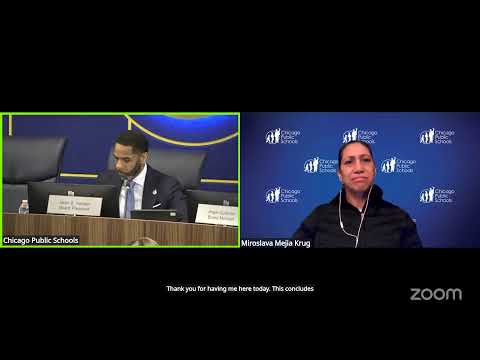
Chicago — Chicago Public Schools finance staff and the City of Chicago presented the board with a short list of financial options on March 14 as members weighed whether to use a remaining $139 million in TIF surplus to cover labor costs and a reimbursement to the city for a portion of Municipal Employees’ Annuity and Benefit Fund (MEABF) costs.
Mike Sekowsky, chief of budget and grants management for CPS, told the board the FY25 proposed amendment would increase the district’s operating budget from $8.43 billion to about $8.57 billion by adding the remaining $139 million of the $298 million TIF surplus the city appropriated in its December budget. The board was told that CPS originally requested $484 million from the city over multiple sessions; the city provided $298 million of which $159 million was already included in the budget passed in July 2024.
"This amendment provides the board the flexibility to utilize the remaining $139 million in TIF surplus funding plus other potential appropriate local resources for the aforementioned pending contracts," Sekowsky said during the presentation.
Board members then heard the city’s financial perspective from Jill Jaworski, Chief Financial Officer for the City of Chicago, who framed the TIF surplus and the contested MEABF reimbursement as part of a longer disentanglement between city and CPS finances. Jaworski said the city has made supplemental payments into municipal pension funds in recent years to improve funding ratios; she described the city’s advance payments as a policy intended to reduce long‑term pension costs.
"The payments that were made initially... track exactly what the agreed upon plan was for payment," Jaworski said, explaining historical intergovernmental agreements and the city’s view that the reimbursed payment was part of a multi‑year understanding. She said the city expects to continue policy steps that allow TIF districts to expire and generate additional surpluses in coming years, but emphasized that the board’s decision on the immediate amendment will affect city‑district relations going forward.
City and outside financial advisors presented a financing alternative intended as a short‑term bridge if the board chose to honor both contract payments and the MEABF reimbursement in FY25. Joe Jukarski, a municipal finance specialist working with DECI Chicago, showed three refunding scenarios that would generate roughly $240 million in near‑term cash by refinancing debt service (reducing near‑term debt service obligations and thereby releasing funds deposited in debt service accounts). The three structures carried different repayment schedules — roughly three, five and 10 years — and were modeled at current market spreads. Jukarski estimated total additional interest cost across scenarios in the low tens of millions to several tens of millions of dollars (present value differences depend on exact terms and market conditions).
CPS CEO Pedro Martinez and district negotiators said they expect most of this year’s labor settlement cost to be wage‑based and estimated that $139 million would be sufficient to cover year‑one costs of pending labor agreements, though the board was warned that the MEABF reimbursement would require additional resources or budget reductions beyond the amendment if paid in full this fiscal year.
Board members engaged extensively with city officials and CPS staff on the legal and policy implications of reimbursing the city. Wally Stock, CPS district treasurer, summarized local property‑tax rules and the district’s constrained ability to increase levy revenue in the short term because of the property tax cap. Several board members asked whether the city’s advance pension payments could be rescinded or reallocated; Jaworski said advance payments already made could not be undone and described the long‑term cost savings the city expects from the pension policy.
Board discussion also touched on governance and the state legislative path: presenters and board members repeatedly referenced a longer‑term goal — disentanglement and parity in how the state funds CPS versus other Illinois districts — but agreed that such changes would require legislative action in Springfield and a multi‑year strategy.
No final budget vote was conducted during the hearing. The board requested additional analyses, and staff said they would return with more detailed options ahead of the board meeting when the FY25 amended budget will be considered.