Get Full Government Meeting Transcripts, Videos, & Alerts Forever!
Get email alerts on the Accelerated Placement Policy topic
No spam. Unsubscribe anytime.
CPS staff propose changes to expanded acceleration policy to broaden access and remove fees
Summary
Chicago Public Schools staff recommended opening a public comment period on amendments to the Accelerated Placement Act policy that would broaden eligibility and remove testing fees for acceleration.
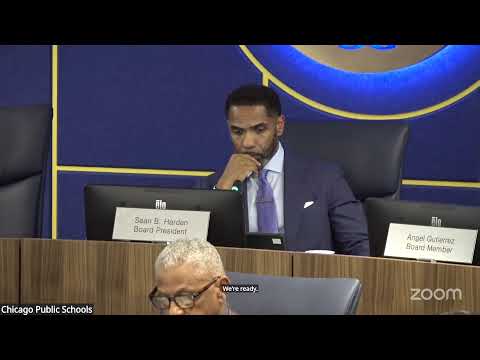
Chicago Public Schools staff recommended that the board open a public comment period on proposed amendments to the district’s Accelerated Placement Act (APA) policy at the May 29 meeting, seeking to broaden access to grade and course acceleration and reduce structural barriers.
Why it matters: The APA policy implements state requirements for early entrance and acceleration and, per staff, has produced uneven access across neighborhoods. CPS said the proposed changes are designed to increase equitable access for students who are “furthest from opportunity.”
What CPS proposed: Erica Baker Perkins, executive director of advanced learning and specialty programs, told the board the policy team recommends expanding eligibility for single‑subject and whole‑grade acceleration to include students who rank in the top 10% of their local school as well as those scoring above proficiency on the Illinois Assessment of Readiness. “We are proposing that we expand access and eligibility for single subject acceleration and whole grade acceleration to include not only students who are scoring above proficient on the IAR, but also those who rank within the top 10% of the students at their local school,” Baker Perkins said. She also described proposals to eliminate the Iowa Acceleration Scale as a requirement for single‑subject acceleration — leaving it for whole‑grade acceleration only — and to introduce an appeals process and to remove external testing fees for families.
Staff said the changes intend to correct access gaps: current data show that 69% of elementary applicants come from a handful of networks while several South and West Side networks account for a small share of applicants. “By adding this local qualification measure, we hope to broaden the pool of eligible students, especially in our underrepresented communities,” Baker Perkins said.
Board questions and implementation: Members asked about outreach and support for families who may not know how to navigate the application process. Board Member DeBerry said, “I'm from one of those succeeding network communities, and I know the parents are advocates... some of our neighborhoods that are lacking, the parents don't know how to navigate as well.” Baker Perkins said staff will host parent information sessions and continue written notification efforts begun under the last policy iteration.
Language access was raised: Member Lopez asked whether testing is available in languages beyond English; staff said Spanish is currently available and that expanding other languages is constrained by the external testing provider. Member Zicor suggested the policy encourage schools to consider non‑test indicators for placement decisions; Baker Perkins said the policy sets a minimum bar and does not preclude schools from using additional measures to identify students.
Next steps: CPS proposed opening the public comment period at the May 29 board meeting. If adopted, implementation details such as parent sessions, notification letters and removal of fees would be part of the roll‑out.
Ending: The proposed change focuses on procedural and access adjustments intended to increase equitable entry points into advanced coursework. Board members emphasized outreach, language access and local implementation supports as essential to meeting the policy’s equity goals.