
CPS officials present FY25 amended budget that adds $139M in TIF surplus; board and advocates spar over pension reimbursement and contract funding
Get AI-powered insights, summaries, and transcripts
Sign Up Free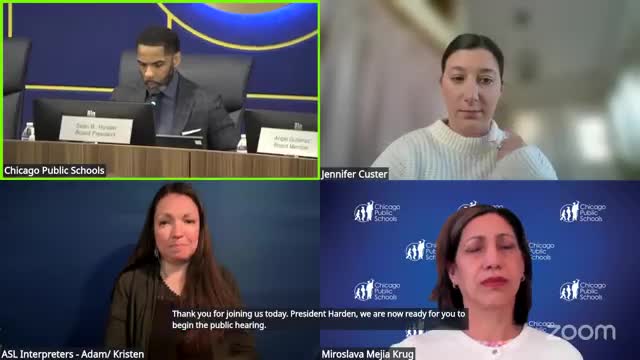
Summary
Chicago Public Schools on March 13 presented an FY25 amended budget that adds $139 million in TIF surplus to the district’s operating plan and would give the Chicago Board of Education flexibility to apply that money toward pending collective bargaining agreements or a city reimbursement tied to the Municipal Employees’ Annuity and Benefit Fund (MEABF).
Chicago Public Schools on March 13 presented an FY25 amended budget that adds $139 million in TIF surplus to the district’s operating plan and would give the Chicago Board of Education flexibility to apply that money toward pending collective bargaining agreements or a city reimbursement tied to the Municipal Employees’ Annuity and Benefit Fund (MEABF).
The proposal, delivered by Mike Zukowski, chief budget officer for CPS, would increase the district’s operating budget from $8.43 billion to $8.57 billion and use the $139 million remaining from a $298 million TIF surplus the city allocated to CPS. The amendment was described as providing the board optionality to fund (1) the pending Chicago Teachers Union agreement, (2) a principals-and-administrators agreement, or (3) an intergovernmental agreement (IGA) to reimburse the city for part of MEABF costs.
Why it matters: board members and union representatives said the board must decide whether the limited funds should go directly to school staffing and contract settlements or to the city to reimburse past pension payments. Board members pressed staff on legal and fiscal constraints; union and community speakers warned that withholding funds from bargaining could lead to a strike or severe classroom impacts.
Zukowski opened the staff presentation by reviewing the FY25 baseline: a total approved budget of roughly $9.9 billion, with $8.3 billion for operating, $611 million for capital and $817 million for debt service. He said the city’s December budget included $298 million in TIF surplus for CPS — $159 million of which was already included in the approved budget — leaving $139 million available for this amendment.
Zukowski outlined the city request that prompted the larger budget conversation: city leaders had sought $484 million to cover several district-related costs this fiscal year. That $484 million, he said, was composed of $97 million of base funding, $62 million earlier included to cover the SEIU Local 73 contract, $150 million projected for CTU and CPAA labor costs, and $175 million to reimburse the city for a MEABF pension payment. With the city’s final allocation of $298 million, CPS received $139 million above the July-approved budget.
Board members repeatedly sought legal and procedural clarity. Board member Boyle asked what would happen if the $139 million were not used for labor agreements; Zukowski said staff had identified the funds and would present options but could not predict all downstream consequences. Board member Gutierrez asked about the Baker Tilly third‑party audit; staff said the audit was near completion and expected "in the coming days." Board members also noted that an amended budget requires a two‑thirds majority to pass, while an IGA with the city would require a simple majority.
Pedro Martinez, chief executive officer of CPS, said the amendment was intended to preserve flexibility: "The amendment gives you that flexibility, so that the money can be used for any of those options that Mike just laid out," Martinez said, urging the board to consider options while protecting classrooms.
Miroslava Mejia Krug, chief financial officer, told members CPS had already pursued debt‑service restructuring for calendar 2025 and that the district had limited additional refinancing options this fiscal year. She said the district had taken steps earlier in the fiscal year to realize about $100 million in savings through debt arrangements.
Public comment at the hearing centered on labor agreements and school staffing. Union leaders and classroom educators urged the board to fund contract provisions already bargained at the table, including smaller class sizes, more special education staff, increased prep time for elementary teachers, and an expanded librarian corps. Jackson Potter, vice president of the Chicago Teachers Union, criticized privatization and urged investments in staffing and smaller classes: "When the district gave away power to unaccountable charter operators... critical public resources were diverted," Potter said during the union remarks.
Jen Conant, CTU charter division chair, urged changes to the district’s charter‑renewal and contract oversight processes in light of Acero school closures and requested conditions that would require charters to use reserves when closing schools. Several parents and teachers from Acero schools asked the board to finalize transition agreements that would keep some Acero campuses in the district network.
Other public comments pressed the board to prioritize classroom staff and supports rather than pension reimbursements. Stacia Scott Kennedy, executive vice president of SEIU Local 73, said district staff should not be asked to shoulder the cost of any budget fixes. Hal Woods of Kids First Chicago warned that reimbursing the city for the MEABF payment "is detrimental to our district’s budget" and said parents and community members overwhelmingly opposed diverting classroom funds.
Board members also debated the TIF process and the city‑district relationship. Members asked staff whether the city could withhold TIF surplus in retaliation if CPS declined the MEABF reimbursement; staff and legal advisers said the TIF surplus distribution is governed by law and is not at the discretion of a single alderman but acknowledged political risk in intergovernmental negotiations.
No formal vote was taken at the March 13 hearing. Staff told the board the amendment would come back for action at the March 20 meeting, and that additional information — including the Baker Tilly audit and further cost estimates tied to unresolved labor agreements — would be made available before that vote.
What remains unresolved: the board must decide whether to direct the $139 million to settle year‑one costs of pending labor agreements (district negotiators said the amount appears likely to cover a year‑one cost) or to approve an IGA reimbursing the city for the MEABF payment (the city’s reimbursement request figure was $175 million). Board members repeatedly asked for clearer, auditable numbers on total contract costs and for outside subject‑matter experts and city officials to appear at upcoming hearings so the board can weigh fiscal and legal consequences.
Next steps: the board will consider an amended budget for a vote at its March 20 meeting, after which any intergovernmental agreement or collective bargaining ratifications would follow the separate approval processes required by law and contract rules.