
Weld County approves first reading of oil-and-gas code changes; board delays pending-ordinance effective date to Sept. 8
Get AI-powered insights, summaries, and transcripts
Subscribe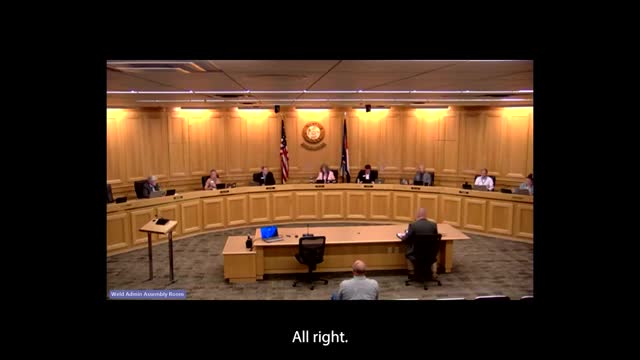
Summary
The Weld County Board of Commissioners approved the first reading of amended Chapter 21 provisions on oil and gas location assessment and pipeline data sharing, and amended the ordinance to make the pending-ordinance doctrine take effect at second reading on Sept. 8, 2025 rather than immediately.
Weld County commissioners on Monday approved on first reading a package of amendments to Chapter 21 of the Weld County Code governing oil and gas location assessments and pipeline permitting, but moved the ordinance’s effective date to the second reading on Sept. 8, 2025. The board also debated whether to apply the pending-ordinance doctrine immediately and amended the ordinance to delay enforcement until the second reading.
The proposals update Article 5 (oil and gas location assessment) and Article 6 (pipelines) and remove the older LAP (location assessment for pipelines) process, county staff said. Planning staff presented the changes as necessary to align local permitting with the state’s evolving regulatory environment and to streamline permitting while protecting public safety.
“State level changes and policy permitting and expectations require local government to ensure that our changes remain clear, consistent, and defensible,” the presenter said. The amendments also ask industry partners to voluntarily provide two tiers of GIS pipeline data: basic centerline information (excluding sensitive details) and a restricted infrastructure dataset for emergency-management use only.
The proposed changes would also adopt the county’s version of the pending-ordinance doctrine, a legal principle sometimes used in Colorado to apply proposed rules to applications submitted during the rule-change period. Several commissioners said they were uncomfortable making the doctrine effective immediately and wanted more time for a scheduled work session between first and second reading. Commissioner Scott James moved to change the ordinance language so enforcement would begin on the date of second reading, Sept. 8, 2025; Commissioner Kevin Ross seconded, and the board approved the amendment and the first reading as amended.
Supporters from industry told the board the amendments would increase regulatory certainty and align local rules with state standards. A representative for Civitas Resources said the changes offer “some efficiencies” and a clearer path for investment.
Staff said the county will schedule a work session between the first and second readings to address definitions and clarifications and that additional edits could be made before second reading. The board set the second reading for Sept. 8, 2025.
The board’s action on first reading does not finalize the code; final adoption requires a second reading and any further amendments at that hearing. The county said staff will continue outreach with stakeholders and schedule follow-up work sessions before the ordinance returns for final consideration.