
Council Bluffs district outlines plan for 400‑student STEM Innovation High School
Get AI-powered insights, summaries, and transcripts
Subscribe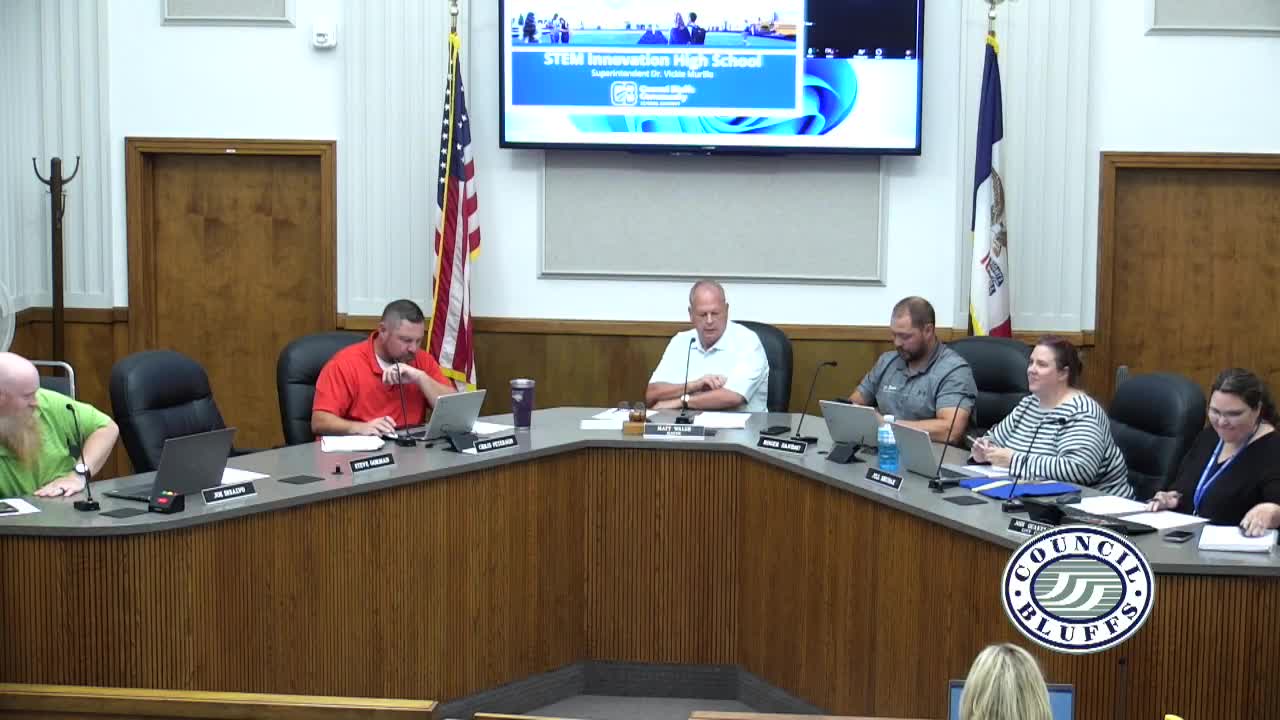
Summary
Council Bluffs Community School District presented concept plans for a 37,700‑square‑foot, 400‑student STEM Innovation High School aimed at industry‑aligned credentials and regional open enrollment.
Dr. Vicki Murillo, speaking for the Council Bluffs Community School District, told the City Council the district is planning a small, specialized STEM high school that would enroll about 400 students and emphasize engineering, P‑Tech pathways and biomedical training. “This is really a bold and strategic response to the regional workforce needs,” Murillo said, describing the school as a “reimagining of the high school experience” and showing renderings of a roughly 37,700‑square‑foot building.
The district proposes 100 students per grade in a full‑day program for grades 9–12 and said it would accept open‑enrollment applicants from neighboring Iowa districts and the metropolitan area. Murillo said the school would not operate traditional sports or marching band programs; students who enroll in the STEM school could return to their home school sites to participate in extracurricular activities under recently passed legislation allowing that arrangement.
Murillo said students would graduate with industry‑recognized credentials or stackable degrees to prepare for careers in engineering, cybersecurity, artificial intelligence, biomedicine and robotics. “They’ll be prepared for high‑demand careers in the field,” she said, adding that the curriculum would be interdisciplinary and project‑based so students can earn required credits in English, math, science and social studies through applied projects.
On logistics, Murillo described classroom, laboratory and maker‑space layouts and the plan to sponsor co‑curricular clubs, competitions and capstone projects. She said the district already purchases seats for other specialized programs (for example, the zoo academy and a health science program at a local college) and that districts, businesses or foundations could sponsor seats for students; the district cited the per‑pupil open‑enrollment amount it currently uses for such arrangements in the presentation.
Council members asked about lottery or selection processes if demand exceeds capacity, schedule and transportation. Murillo said the school would open fully staffed and described models in other districts where grade levels are phased in (for example, opening with freshmen and sophomores and adding upper grades later). She said the district would likely reserve some seats by sending district allocations to partner sites so initial enrollment reflects a cross section of the district and region.
Why it matters: Murillo framed the school as a regional economic development tool that could retain talent and attract tech employers by producing graduates with work‑ready STEM credentials. She identified existing local successes in robotics and cited national and regional job‑growth projections for STEM fields as a rationale for the investment.
The council did not take action on the proposal; the presentation concluded with an offer to return with more details on governance, enrollment policy and cost structure. The district did provide specific size and enrollment figures during the presentation but did not present a finalized budget or firm site at this meeting.