
Council briefed on updated purchasing thresholds, electronic bidding and exception rules
Get AI-powered insights, summaries, and transcripts
Subscribe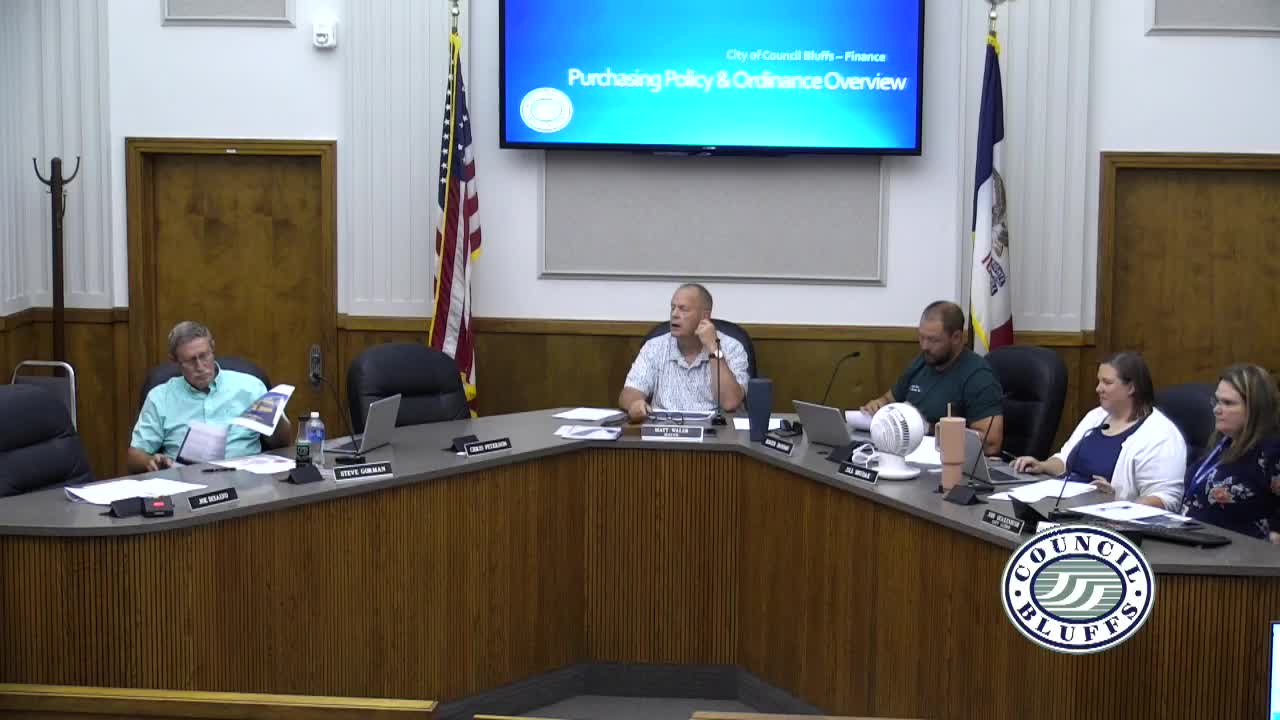
Summary
City staff summarized revisions to the municipal purchasing ordinance adopted in August 2023, explained new dollar thresholds for procurement methods, the city's electronic bidding platform and limited uses of an exception policy.
Council Bluffs City Council members heard a presentation on the city's purchasing policy and related ordinance at the meeting, including thresholds adopted in August 2023, the city's use of an electronic bidding platform and defined procurement exceptions. Purchasing Officer Daniel summarized the changes and how staff apply them.
The presentation explained that the ordinance (last revised in August 2023) sets dollar thresholds for procurement methods to align with state requirements and local best practices. "This ordinance was designed to provide efficiency and to protect public funds," Daniel said. He said the current thresholds put noncompetitive purchases at up to $10,000; a good-faith effort to obtain three quotes for purchases from $10,000 to $40,000; and a formal bid process for purchases greater than $40,000, changes adopted after an analysis of other Iowa municipalities.
Why it matters: the thresholds determine when city staff must solicit competition, when formal bids are required and which purchases require council approval. Daniel said professional services over $75,000 are brought to the council for approval and that public-improvement project thresholds are set and regulated by the state of Iowa under chapter 26.
Staff also described the city's electronic bidding platform, Ion Wave, which allows vendors to register by industry and receive notices when the city issues relevant solicitations. Daniel said Ion Wave standardizes submission formats and helps ensure the public and vendors can view available opportunities.
Council members asked how vendors are added to the bid list and whether proposals or qualifications are immediately public after submission. Daniel and another staff member said firms must register to be notified; proposals submitted in response to requests for proposals (qualifications-based solicitations) are available for public review from Community Development but are not typically distributed immediately as a bid tab would be.
On procurement exceptions, Daniel outlined several allowable methods drawn from state definitions: sole source (one supplier uniquely capable), single source (competitive sources may exist but standardization or warranty reasons favor a single supplier), cooperative purchases (two or more entities combine buying power) and emergency purchases (immediate need to protect operations or property). He noted the council discourages use of the city's exception policy and that the mayor approves sole- and single-source requests and cooperative purchases above $40,000; the purchasing officer can approve cooperative purchases under $40,000.
The presentation concluded with staff guidance on when professional services, surplus property sales and public-improvement projects follow separate processes and when items must be referred to the council for approval.