
Council approves rural sanitary sewer option for Maple Grove area, rejects immediate annexation
Get AI-powered insights, summaries, and transcripts
Subscribe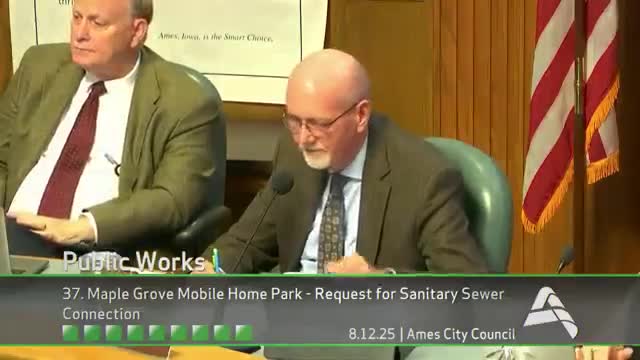
Summary
Ames City Council approved allowing sanitary sewer service to the unincorporated Maple Grove and adjacent properties without annexation, directing property owners to pursue voluntary next steps and noting the public‑health benefit after microbial testing showed human waste markers in College Creek.
The Ames City Council on Aug. 12 voted to approve a staff recommendation to permit sanitary sewer connections to properties near the West city limits — including Maple Grove Mobile Home Park — under a rural sanitary sewer service arrangement that does not require immediate annexation. Staff presented test results showing human microbial markers in College Creek and said connecting properties would address a public‑health concern. The council chose the option to allow sewer connection without annexation rather than immediate annexation, but noted property owners must take steps to move the process forward.
Staff background and test results
Public Works staff told the council a sanitary sewer extension installed in spring reached Boone County but originally contained no service connections. Several adjacent property owners, including Maple Grove Mobile Home Park, asked about connecting. The city has no current mechanism for connecting properties outside city limits unless annexed or a rural sanitary sewer rate is adopted. Staff said recent microbial source tracking on College Creek showed the primary source was human, providing added urgency to address potential septic leakage.
Options considered
Two broad options were presented: (1) approve a rural sanitary sewer service agreement that allows non‑annexed properties within a defined area to connect under a higher, “rural” sewer rate similar to the city’s rural water rates; or (2) pursue voluntary annexation of the properties, which would trigger city service obligations and the usual annexation consequences for properties within 200 feet, plus potential participation in drainage district responsibilities. Staff recommended option (1) to address the water quality concern more quickly.
Council concerns and clarifications
Council members asked operational questions, including minimum flows to avoid sewer stagnation, the need for engineering design and whether the city would require connections for all properties along the new main. Staff said Maple Grove is large enough to provide adequate flow, but small individual connections could sometimes require additional operations or maintenance. Public Works said any extension designated as a public main would require licensed‑engineer design and city review before acceptance as a public asset. Staff also said if annexation later occurs, the city would assume drainage‑district obligations where applicable; annexation of drainage‑district lands could trigger cost‑sharing or maintenance responsibilities.
Ownership and next steps
The council heard that Maple Grove Mobile Home Park and neighboring parcels are owned by a small number of commercial owners rather than many individual owners, which simplifies paperwork for voluntary annexation if the owners choose. Staff emphasized the property owners must initiate the annexation process if they want the route that requires annexation; otherwise the rural sewer rate approach is available but voluntary. One council member noted past difficulties getting property owners to follow through on voluntary annexation requests and asked for staff to consider ways to ensure prospective purchasers are made aware of obligations tied to properties.
The council voted to approve the rural sanitary sewer option without annexation and required that any public‑main extension meet city design standards and be reviewed prior to acceptance. The motion passed on voice/roll vote.
Why it matters
Staff said the microbial testing showing human markers in College Creek made action urgent for public health and environmental reasons. The council’s choice to permit sewer connections without annexation allows a faster route for properties in need of sewer service while retaining the option for future annexation if property owners pursue it.
Provenance: Maple Grove sanitary sewer discussion and vote occurred at the Aug. 12 meeting (transcript roughly 3416–4693).