
Ames council names coal‑yard site preferred location for new gas generation; staff to start design
Get AI-powered insights, summaries, and transcripts
Subscribe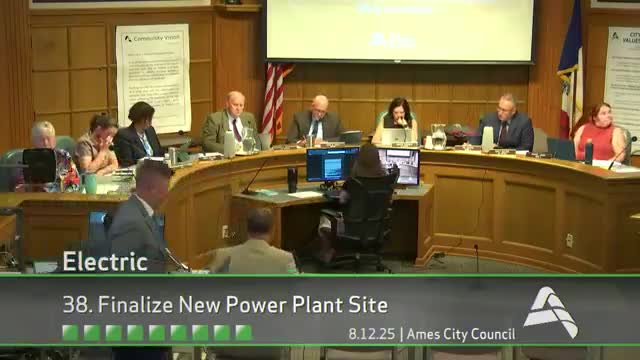
Summary
After reviewing multiple alternatives, Ames City Council chose the existing coal‑yard site as the preferred location for new natural‑gas reciprocating engines to replace aging units, citing infrastructure savings and reliability; staff will proceed with design work and next steps toward permitting and procurement.
The Ames City Council on Aug. 12 approved a staff recommendation to designate the city‑owned coal‑yard property near the existing Ames Plant substation as the preferred site for new generation to replace aging units, directing staff to proceed with detailed engineering and design. Staff and consultants presented multiple siting options — northwest and southeast parcels, industrial park areas and the coal yard — and analyzed gas supply, proximity to the 161 kV transmission network, permitting and visibility and cost differences. The council voted to approve the coal‑yard site as the preferred location.
Staff said the city needs new generation because Unit 7 (built 1967) is approaching the end of its useful life and replacement capacity is required by May 2028. The city’s search prioritized proximity to a 161 kV line, adequate natural gas supply (staff estimated an 11,000 dekatherm peak need) and the ability to distribute power across the city for reliability during transmission outages. "One of the core focuses is having generation within the city so that if the outside transmission world falls down we have this generation to pick ourselves up," staff said.
Alternatives studied and rationale
Staff examined several alternatives at a high level. Sites away from existing transmission (northwest acreage and south/east industrial parcels) would have required new substations or long new 161 kV line segments and additional gas infrastructure, adding roughly $24–25 million to project cost estimates. Staff said those options could also interfere with future development and face longer interconnection reviews with the regional transmission operator (MISO). Rerouting transmission, building new substations and buying multiple parcels were the primary drivers of additional cost.
By contrast, the coal‑yard site already abuts the Ames Plant 161 kV substation, offers a direct access point to an existing large gas line the city helped fund, and avoids land acquisition. "This is the one site that we do have under our control," staff said. Using the coal yard for new reciprocating internal combustion engines would avoid building a new substation and extensive new transmission, producing an estimated $18–$27 million cost savings versus other sites in the 50,000‑foot analysis. The staff presentation modeled a worst‑case visual scenario with multiple 100‑foot exhaust stacks but noted that actual stacks could be shorter, and the plant footprint could be designed to minimize visibility and include landscaping and architectural treatments.
Technical, permitting and timing considerations
Staff emphasized technical issues the council must weigh. Natural gas capacity is a limiting factor: staff said the city needs roughly the same dekatherm capacity as it presently uses when existing peakers run. Interconnection with MISO can add months to years depending on the planning horizon; staff noted an expedited MISO process is available but limited in capacity and closed for the current quarter. A failure to secure timely interconnection could push the schedule into multi‑year studies. Staff estimated design, approvals, equipment ordering and construction could be completed if the city moves promptly: they plan to issue a design agreement with Sergeant & Lundy and aim to have equipment ordered by year’s end to meet a May 2028 operational objective.
Noise, vibration and aesthetics
A major part of the presentation addressed community concerns about sound, vibration and visual impacts. Staff and consultants described baseline sound measurement plans and attenuation measures used at comparable new generation sites: engine enclosures, ductwork attenuation, HVAC and inlet/outlet silencing, and radiators with low‑noise fans. The consultants said designs can meet typical residential limits (e.g., 55 dBA nighttime) and suggested DBC (C‑weighted) limits to control low‑frequency noise — industry practice for generation near residences. Staff also showed examples of modern energy centers that combine high‑quality architecture, enclosed engine buildings and public‑facing exhibits; one council member suggested using landscaping and building design to create a positive downtown edge and potential redevelopment catalyst.
Costs and customer impact
Staff estimated moving the site away from the coal yard could add roughly $24 million in upfront costs; using that figure in the utility’s financial forecast would translate to about a 3% additional electric rate increase in the first year of debt service and about a $35 per year increase for a medium residential customer over a 10‑year projection, staff said. Staff emphasized the range depends on final site, equipment and financing choices.
Council decision and next steps
After discussion and public comment, the council voted to approve the coal‑yard site as the preferred location for new generation, and instructed staff to advance design and permitting and to work with Sergeant & Lundy on architecture options, including aesthetic treatments. Staff will pursue baseline noise studies and continue interconnection planning with MISO. The council also requested staff explore attractive architectural and landscape treatments (staff said architects from the engineering firm would be engaged in initial design) and to return with site plans and cost details.
Why it matters
The decision begins the transition away from decades‑old steam generation and waste‑fuel operations toward a modern fleet of reciprocating engines designed to provide reliability and lower emissions than the current configuration. The chosen site minimizes land acquisition and transmission costs, accelerates interconnection work and preserves options for architectural design, but it still requires careful work on noise mitigation, permitting and equipment procurement to meet the May 2028 target.
Provenance: staff presentation and Q&A occurred at the Aug. 12 council meeting (transcript roughly 4725–9151).