
Ames staff outline plan for citywide curbside recycling; council asks for public outreach
Get AI-powered insights, summaries, and transcripts
Subscribe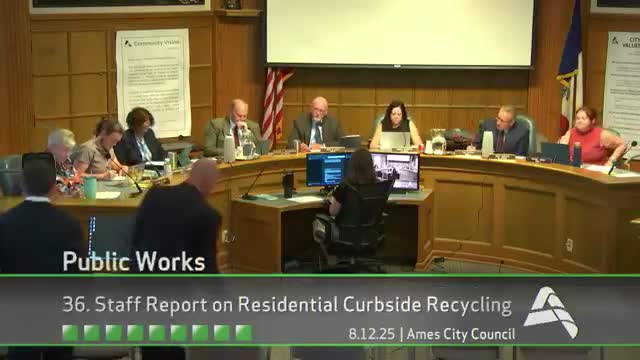
Summary
City staff presented options for a citywide curbside recycling program tied to the new resource recovery and recycling campus; council directed staff to develop a community communications and input plan before returning with recommended next steps.
City of Ames staff presented options for a citywide curbside recycling program on Aug. 12, saying the effort is needed as the city transitions from its current waste-to-energy process to the new Resource Recovery and Recycling Campus and to meet Iowa DNR diversion-based fee incentives. Staff described alternative service models, container ownership options, contractor structures, timeline and costs, and urged the council to provide direction after public outreach. The council voted to ask staff to develop a communications plan and create opportunities for public input before the council considers a decision.
City staff told the council the proposal responds to the resource recovery plant closure and the opening of the Resource Recovery and Recycling Campus (R3C). "As we move away from waste to energy, we will have to find different ways" to divert material, the presentation said, adding that recycling will help lower DNR fees tied to landfill diversion. Staff described survey results showing resident support: more than 80% of respondents in a 2023 satisfaction survey supported recycling in some form and 70% in 2024 said reducing waste emissions is a high climate priority.
Staff outlined four basic access models: (a) universal cart for every household with a utility fee; (b) everyone charged but carts issued only to households that opt in; (c) opt-in where only participating households are charged; and (d) the current drop-off model only. Staff recommended either model (a) or (b) to reach diversion goals because they produce the highest participation and tonnage. "We believe more access is needed to reach our goals for diversion and participation," the presentation said.
Two delivery options were described: (1) require existing haulers to provide curbside recycling to their customers and (2) a citywide contract with a single provider paid through the city utilities bill. Staff recommended a single contractor model to ensure consistent rules, lower per-household costs through scale, reduced truck traffic and better tracking of diversion, while noting it would remove the private choice of hauler for recycling. On container ownership, staff favored a hybrid where the contractor furnishes city‑branded carts and amortizes their cost over a five‑year contract (adding roughly $1 per month per household) so the city ultimately owns the assets.
Staff proposed every-other-week collection — the common national practice that balances cost and diversion — and said an initial program would cover single‑family and up to four‑unit properties (about 60% of Ames housing). Multifamily properties would be addressed through pilots and potential future policy changes; staff noted that multifamily collection is a common challenge and that other Iowa communities require multifamily recycling. On partner jurisdictions in Story County, staff proposed optional pricing or trailer drop‑offs to allow those communities to participate or run their own programs.
Timeline: staff estimated 9–12 months from issuance of an RFP to service startup, with a likely mid‑2027 operational date if a contract route is chosen. Because the R3C may open later, there could be a short period during which recyclables must be hauled to Des Moines, temporarily raising costs. Staff also warned that recyclable commodity markets and processing tipping fees are volatile and that the city must decide how much price risk to accept in contractor compensation and customer rates.
On education and contamination control, staff emphasized outreach and contractor performance incentives or penalties to manage contamination and ensure service quality. They also noted the importance of partnering with Iowa State University for coordinated messaging and leveraging the university's sustainability staff for outreach.
Discussion and council direction
Council members asked about enforcement and contamination: staff said the city could build contamination response into the contract and that education would be the first step, with the city retaining options such as removing carts from repeat offenders to avoid contaminating the commingled stream. A council member asked whether haulers could fine customers for contamination; staff said fines and enforcement approaches would be part of contract design and policy decisions. Council members pressed on multifamily solutions, equity for residents with limited mobility, and the need for a strong public engagement plan. One council member noted, "I just can't think of another thing we've asked the community to change behavior on as significantly as this," and requested both pre‑deployment and post‑launch communications.
Council action
After discussion, a council member moved that staff develop a communications plan describing the program options and ways for public input; another council member seconded. The council voted by voice vote in favor and staff will return in September (or after a brief public input process) with recommended decisions and further details, including possible contract structure and fees.
Why it matters
A decision on curbside recycling affects diversion from the landfill, city operating costs and resident bills. It also shapes how the new Resource Recovery and Recycling Campus will function and how residents across single‑family and multifamily housing will access recycling. The council’s request for a communications plan indicates that public acceptance and operational details (service levels, fees, and contractor obligations) will be central to the next stage.
What’s next
Staff will conduct public outreach over the next several weeks, refine costs and contract options, and return to council in September with recommendations and final designs for council direction.
(At the Aug. 12 meeting the staff presentation and much of the discussion on curbside recycling occurred between transcript minutes 1044.07 and 2086.41.)