
Ames zoning board denies variance for covered entry at 1420–1422 Coolidge Drive
Get AI-powered insights, summaries, and transcripts
Subscribe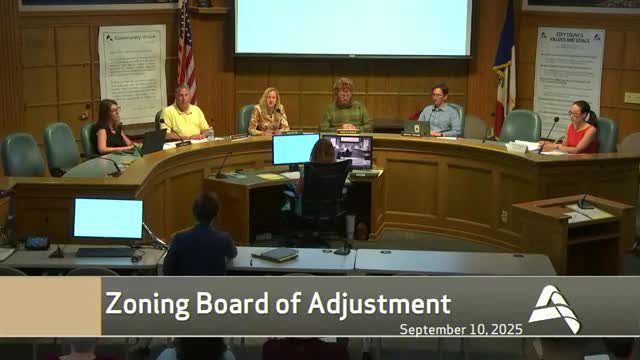
Summary
The Ames Zoning Board of Adjustment denied a homeowner’s request to keep a covered entry that projects roughly 3½ feet into an 8‑foot side yard setback after staff said the property did not meet the state’s new practical‑difficulties criteria and no unique physical hardship was shown.
The Ames Zoning Board of Adjustment on Sept. 10 denied a variance request that would have allowed an existing covered entry at 1420–1422 Coolidge Drive to remain as built, with the roof projecting about 3½ feet into an 8‑foot side yard setback. The board voted to deny the request after hearing staff analysis and testimony from the homeowner and neighbors.
City planner Benjamin Campbell said the roof projects about 5 feet 4½ inches from the house and that the encroachment was identified during a rental inspection because no building permits had been obtained. "The property of 1420/1422 Coolidge Drive does meet all of the minimum standards for lot area and lot width," Campbell told the board, but he advised that the property does not show the kinds of unique, property‑specific physical conditions the new state standard for practical difficulties requires. Campbell said the city staff therefore recommended denial.
Applicant Tim Ashley, who identified himself as the current owner and resident of 1420 Coolidge, said the structure was added because his mother, who lives in the rental unit, needs a dry, covered landing in winter to reduce fall risk. "When it was first noticed during the inspection, I immediately applied for the building permit and, of course, the building permit individual denied," Ashley said. He said an awning or a two‑foot minor area modification would not cover the landing sufficiently to keep it safe in drifting snow. Tess (legal name Terry) Ashley, who also spoke, described the landing as a safety issue for the elderly resident and said the side panels are removed each summer.
Board discussion focused on the new statutory practical‑difficulties criteria, which staff said took effect this summer and applies to numerical dimensional variances. Staff summarized the four criteria: (1) the practical difficulties must be unique to the property and not self‑created; (2) granting the variance must not significantly alter the essential character of the surrounding neighborhood; (3) the spirit of the ordinance must be observed; and (4) substantial justice must be done. Campbell said age of a resident and recurring weather are not considered unique physical conditions under the new standard.
After deliberation, a board member said the lot’s diagonal property line and how the house sits on the lot could qualify as a unique characteristic; other members disagreed with staff on that point but ultimately concluded the application failed to meet the standards. A motion to deny the variance carried and the board advised that anyone desiring to appeal must do so to a court of record within 30 days after filing of the decision.
No further action on this item was taken at the meeting; the board moved on to the next agenda item.
Outcome: Denial of variance request for 1420–1422 Coolidge Drive. Vote recorded in meeting: motion carried.