
Dubuque council remands rezoning request for West 30 Second Street back to advisory commission after neighborhood opposition
Get AI-powered insights, summaries, and transcripts
Subscribe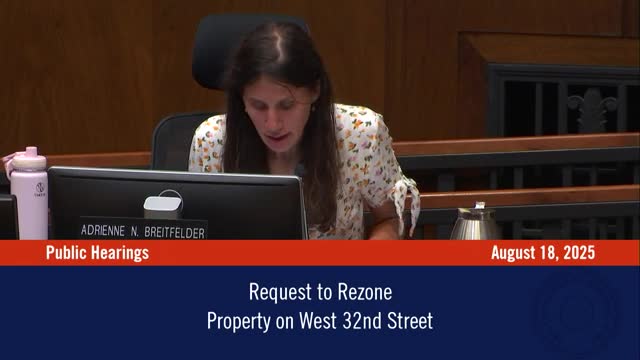
Summary
The City Council voted 7-0 to remand a request to rezone a vacant lot on West 30 Second Street from R‑1 single‑family residential to OR office‑residential, sending the application back to the Zoning Advisory Commission for possible conditional rezoning after neighbors protested and the commission recommended denial.
The Dubuque City Council on Monday voted 7-0 to remand a rezoning request for a vacant lot at West 30 Second Street back to the Zoning Advisory Commission for consideration as a conditional rezoning.
The request, filed by applicant Sherry Ehrlich and presented at the hearing by Tom Larson, sought to change the site from R‑1 single‑family residential to OR office‑residential with the applicant saying the intent was to build a real‑estate office on the property. The Zoning Advisory Commission had recommended denial by a 0–5 vote, which triggered a super‑majority requirement for any straight rezoning by the council.
Remanding the matter to the commission means the applicant can submit a revised, conditional rezoning that would list specific uses and written conditions; the commission would again hold a public hearing and then the council could consider the resulting recommendation. City planning staff explained that remanding also requires re‑notification of property owners within 200 feet and that the applicant would not need to pay the application fee again.
At the council public hearing, two nearby residents — Joni Heitzman of 3152 West 30 Second Street and Genevieve Voss of 3160 West 30 Second Street — spoke against the rezoning. Heitzman said nearly all notified property owners opposed a change and described the parcel’s context: “The arterial does serve as a boundary. It would be our preference that that boundary stands true,” she said. Voss said she did not want a business across from her driveway and worried about what could be sold or developed there in the future.
City staff noted the lot is roughly 23,086 square feet (city records), is undeveloped, and sits along a curve of West 30 Second Street, a minor arterial. Staff said more than 20% of the land within 200 feet was in opposition — a factor that also triggered heightened voting thresholds. Planning staff also told the council the applicant had submitted a written request the same day asking that the application be remanded for consideration as a conditional rezoning and that the applicant is willing to prepare a site layout and proposed conditions for the commission’s review.
Council members who spoke in favor of remand framed it as a way to allow further neighborhood discussion and for the applicant to present a more tailored proposal. “This opens new opportunity to maybe fix this so it’s appealing to you,” Council Member Jones said before the roll call. Several council members urged the applicant to meet the neighbors and the commission to discuss design, access and signage as part of a conditional proposal.
The motion to remand, made by Council Member Jones and seconded by Council Member Farber, passed by roll call vote 7–0. The council set no new date for a return; planning staff said the remand would restart the commission’s public‑hearing process and the item would return to the council when the commission had a recommendation.
Next steps: If the applicant files a conditional rezoning proposal, staff will re‑notify owners within 200 feet and the Zoning Advisory Commission will hold another hearing. Any final ordinance granting a conditional rezoning would require submission of the applicant’s written agreement to the conditions and later council action.