
Dubuque council approves multi‑phase sewer design contracts and adds engineering FTE to oversee projects
Get AI-powered insights, summaries, and transcripts
Subscribe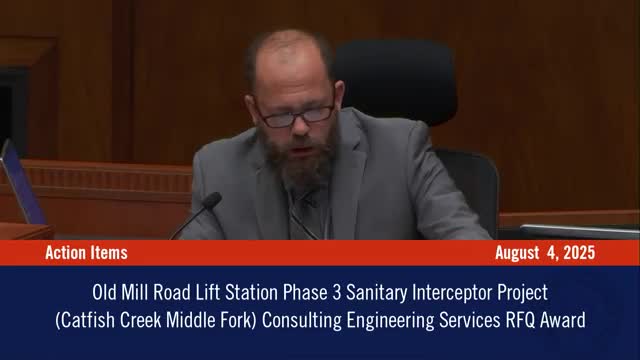
Summary
Council authorized RFQs and contract negotiations for Old Mill Road lift station phases, track‑line sewer relocation, and added a field engineering technician position to support multi‑year sewer projects, citing savings over consultant fees.
The Dubuque City Council on Monday authorized consultant agreements and released requests for qualifications for multiple sewer and interceptor projects and approved an additional full‑time field engineering technician for the engineering water resources team. Council authorized staff to negotiate with HDR Engineering for design of the Old Mill Road Lift Station Phase 3 Catfish Creek Bridal Fork interceptor project and with Infrastructure & Environment for Phase 4 (Catfish Creek South Fork). The council also approved an RFQ to develop the Track Line sanitary sewer reconstruction project, which would relocate roughly 5,150 feet of aging 12‑inch sanitary sewer that runs adjacent to railroad tracks. City Engineer Gus Sahoyas told the council the existing clay tile sewer installed in the 1920s is undersized, difficult to maintain because of sand inflow and railroad proximity, and requires relocation to city right of way. "We cannot maintain it at all... We just have to move it out of that area," Sahoyas said. Council members praised having multiple qualified firms respond and said splitting phases between firms was intended to match specialized experience — for example, HDR for railroad crossing expertise and another firm for environmental work — and to speed delivery. Staff said the projects are associated with the city's consent‑decree sewer sheds and are planned across multiple fiscal years. To support inspection and project management, the council approved adding one full‑time field engineering technician (FET 1/2) funded from CIP project budgets. Sahoyas said in‑house staffing will save the city money compared with paying consultant inspection rates (staff estimated consultant costs as roughly $125 per hour), and that the new position will support a concentrated set of major projects over the next 2½–3 years with potential to absorb attrition after that period. The council approved the contract authorizations and the additional FTE on unanimous votes and directed staff to proceed with scope negotiations and project scheduling. Members said relocating the track‑line sewer will reduce long‑term maintenance costs and reduce coordination constraints with the railroad, while the added staff position will help the city retain institutional oversight of projects.