
Dubuque council approves midyear pay fix to resolve police supervisor wage compression
Get AI-powered insights, summaries, and transcripts
Subscribe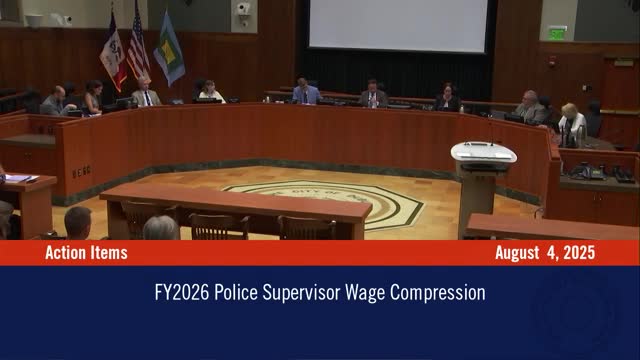
Summary
City Council voted 6-1 to approve a midyear pay adjustment to correct wage compression between Sergeants/Corporals and non‑bargaining police supervisors after city staff said the issue was missed during the budget process.
The Dubuque City Council voted 6-1 Monday to approve a midyear pay adjustment aimed at correcting wage compression that left some non‑bargaining police supervisors paid only marginally more than long‑service bargaining‑unit officers. The measure, moved by Council Member Jones and seconded by Council Member Wethal, follows an internal review by police and city staff that found recent union contract step increases had re‑introduced a compression problem the council had previously directed staff to fix. City Manager Mike Van Milligen told the council the omission was an administrative oversight during a large pay‑classification implementation. "I'll be candid with you. I missed this," Van Milligen said, describing why the recommendation did not arrive during the formal budget process. The issue, city officials said, affects incentives for experienced officers to seek promotion to lieutenant or other command roles. Chief of Police Jeremy Jensen had recommended the pay correction to preserve promotion incentives and to retain command‑level staff. During the discussion several council members urged caution. Council Member Resnick said the change should be monitored and suggested treating it as a short‑term pilot so the city can evaluate unintended consequences. "I would recommend ... we treat this as a one‑year pilot," Resnick said. Other members, including Council Member Jones and Council Member Wafford, said the city must remain competitive to retain supervisors and attract candidates for promotion. City Manager Van Milligen said the department is carrying a substantial number of vacancies and that the wage adjustments will be covered from budgeted police wage lines without increasing taxes. "We've had a challenge ... in recruiting police officers and we pretty consistently had about 15 vacancies," Van Milligen said, adding that projected vacancies exceed the cost of the adjustment. Assistant City Attorney Jason Lehman told the council no public hearing was required because the change transfers funds within an already‑budgeted department and does not alter tax or assessment levels. The roll call showed six votes in favor and one opposed; Council Member Resnick cast the sole dissenting vote. The council directed staff to include the adjustments in next year’s budget materials and pursue ongoing monitoring to identify future compression issues. The council’s action is expected to be incorporated into FY 2026 payroll implementation and will be reflected in the department’s FY 2026 budget presentation.