
Dubuque rolls out license-plate readers and new signage in phased smart-parking upgrade
Get AI-powered insights, summaries, and transcripts
Subscribe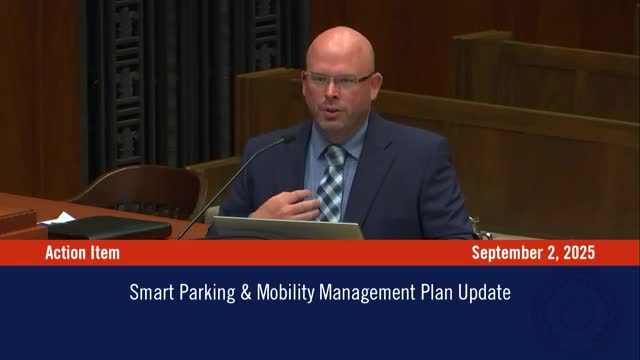
Summary
City officials described staged implementation of new ramp signage, license-plate recognition, pay-on-foot stations and a data dashboard designed to reduce congestion, increase permit capacity and improve revenue forecasting.
Mayor Brad Cavanaugh presided over an update Tuesday on the city’s Smart Parking and Mobility Management Plan as Transportation Services Director Ryan Nucke outlined a phased rollout of new ramp signage, license-plate-recognition (LPR) cameras, pay-on-foot stations and a data dashboard.Photo: Transportation staff said two ramps are active and a third will go live this week. The upgrades aim to ease exit congestion and give staff real-time occupancy and revenue data.Nut graf: City officials said the technology will help reduce congestion at ramp exits, make enforcement and customer service faster, and produce reliable occupancy and revenue figures the city can use for budgeting and for planning on-street parking changes.Body: Nucke said the project updates garage wayfinding and paint schemes and installs digital signs that report capacity at visible approach points. He described the LPR system that reads license plates for permit holders to speed entry and exit and a credit-card-only exit lane for transient parkers to reduce outbound queues. “We want these signs to be informative so people know what to do, how to operate our ramps,” Nucke said. Staff also described a pay-on-foot station inside stair lobbies that accepts cash and cards and ties the printed ticket to the vehicle’s license plate so prepayment opens the exit gate automatically. The city has added live alerts to its operations dashboard so technicians receive notices about jams, low ticket supplies or other hardware problems before they become customer-facing incidents. Officials said the dashboard also shows permit-holder counts, transient-parkers, occupancy levels by floor and weekly revenue totals, which the city plans to use in next year’s budget. Two ramps—the intermodal ramp and the central ramp—are active in the system; the Fifth Street ramp was scheduled to turn on later this week, Locust ramp in September and Iowa Street in October. Nucke said staff deliberately activated ramps one at a time “so we would figure out what’s working well and how to communicate it better.” He said the phased approach lets a small operations team support users and work out issues before broader deployment. Several council members and downtown stakeholders asked about customer support and equity. Nucke said each exit lane includes a help button that connects callers to parking staff; staff can view the pay-station screen remotely and guide users. He said a 15-minute grace period is standard after payment to allow time to walk to a vehicle. The city plans an on-street parking request-for-proposal (RFP) this fall. Nucke told the council the RFP will require any on-street vendor to interoperate with the ramp software and the LPR system so the city can present unified availability information to the public and ultimately deliver a user-facing map or app. Closing: Council accepted the presentation and directed staff to continue with the phased rollouts and the on-street RFP work. The action was recorded as receiving and filing the presentation; the motion passed 7-0.