
Planning commissioners deny rezoning for concrete ready‑mix plant near Highway 92 after extended public opposition
Get AI-powered insights, summaries, and transcripts
Subscribe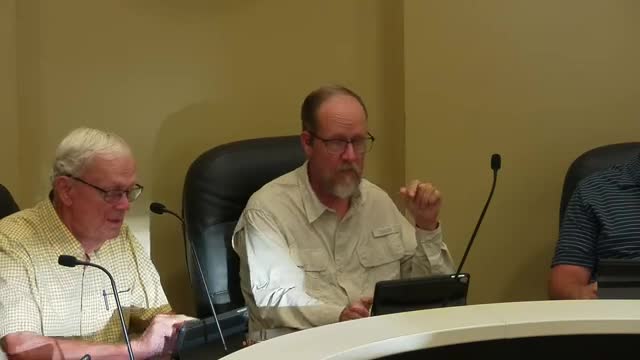
Summary
The Mecklenburg County Planning Commission voted to deny a rezoning request to allow a concrete ready‑mix plant on a parcel near Highway 92 after residents raised noise, dust, traffic and water‑quality concerns; the applicant said the plant would relocate from Microsoft property and operate under DEQ permits and stormwater controls.
The Mecklenburg County Planning Commission on a unanimous roll call vote denied a rezoning request to allow a concrete ready‑mix plant on a portion of two parcels along Highway 92.
The application, presented by civil engineer Gerald Hooten of V & B Consultants and Robert Eley of Commercial Ready Mix, proposed rezoning “plus or minus 3 acres” from agriculture to Industrial M‑1 for a ready‑mix concrete plant, supporting office, admixture storage, bins and material storage.
Commissioners said they were responding to sustained public opposition at Tuesday night’s hearing; residents and neighborhood representatives cited noise from concrete trucks and plant operations, silica dust and potential groundwater impacts, and increased heavy‑truck traffic on Highway 92, a corridor already used by the Microsoft site and a nearby landfill.
The developer and project team described mitigation and permits. Gerald Hooten said the rezoned portion would be “plus or minus 3 acres” separate from the parent parcels and that the operation would hold Virginia permits, including a Virginia Pollutant Discharge Elimination System (VPDES) permit and a stormwater management permit if more than one acre is disturbed. Hooten described concrete‑lined sediment basins and quarterly testing and said the site “will be required to have a site plan” and must address VDOT and county comments. Robert Eley, representing Commercial Ready Mix, said the plant is being relocated from Microsoft’s property and that the company operates 15 plants regionally; he told the commission the company uses an environmental firm to check compliance and that “we have to control the dust when we're loading.”
Residents countered that the proposed industrial use would be incompatible with long‑established homes and farms in the area. Angela Bacon, who said she represents Bluestone Group and that her property sits directly behind the proposed site, urged commissioners to “deny this rezoning request,” calling it “spot zoning” that would “permanently change the character of our rural neighborhood.” Other speakers cited well water and livestock concerns, bus stops and schoolchildren on Highway 92, and the frequency and size of heavy trucks. Ellen Walker, who identified herself as a nurse of more than 40 years, said, “I'm very concerned about the dust and things that will come into the air.” Tom Schluter, a nearby resident, said wind patterns would carry dust onto pastures and that equine health could be affected.
Project details discussed at the hearing included operating hours and traffic: Hooten told the commission normal operating hours would be 7 a.m. to 6 p.m., with the last trucks arriving about 6 p.m.; Eley said the current operation runs about six trucks from the plant. Hooten noted buffers and existing pine plantings on the larger parcel and said the nearest property line is about 150 feet from the rezoned footprint and roughly 200 feet from the nearest house.
After public comment and discussion, a commissioner moved to deny the rezoning “due to the concerns that have been expressed here tonight.” The motion was seconded and carried on a roll call of commissioners in favor; the county staff noted that construction plans, VDOT comments, county site‑plan review and soil‑and‑water approvals would have been required if the rezoning had passed.
What happens next: because the commission denied the rezoning, the applicant may choose to revise the application, pursue a different site, or pursue other administrative remedies under county rules. The county did not set a follow‑up schedule for a revised application at the hearing.