
Economic development leaders detail uranium enrichment projects, Triple Rail site work and AI data-center interest at fiscal court
Get AI-powered insights, summaries, and transcripts
Subscribe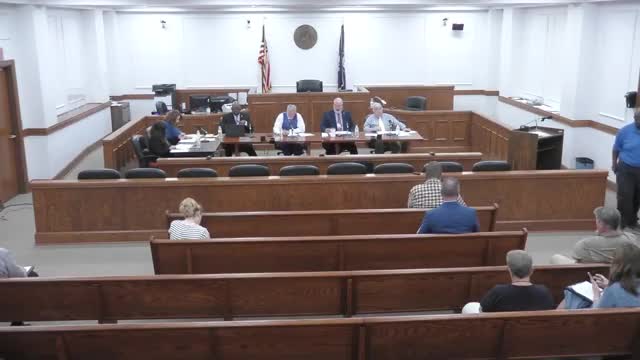
Summary
Greater Paducah Economic Development Organization updated McCracken County fiscal court on two uranium enrichment projects at the Department of Energy site, Triple Rail site improvements and interest from large-scale artificial-intelligence data centers.
Bruce Wilcox of the Greater Paducah Economic Development Organization told the McCracken County fiscal court on Aug. 25 that two uranium enrichment projects and work at the Triple Rail industrial site are the largest recent economic developments for the region. "At our peak, The United States produced about 90% of the world's enriched uranium. Today, we produce less than 1%," Wilcox said, describing national context for local projects.
Wilcox said a company at the Department of Energy-owned Paducah site has signed a decades-long lease to develop a U.S.-owned uranium enrichment facility and will produce low-enriched uranium (LEU) and high-assay LEU. He said that project would employ about 140 full-time workers and involve an estimated $1,500,000,000 in investment, with a projected recurring annual economic impact "of over $71,000,000 per year." He also summarized a separate company, Global Laser Enrichment, which has filed portions of an NRC license application; Wilcox said Global Laser Enrichment is projecting 300–400 employees and that staff use 350 as an average, with a potential recurring impact of roughly $175,000,000 per year.
Wilcox said both enrichment companies expect to coordinate licensing with the Nuclear Regulatory Commission and that General Matter (as stated in the presentation) planned to begin non-radiological site work later in the year while pursuing NRC approval. He added that the Kentucky Nuclear Energy Advisory Committee visited Paducah in June for briefings.
On local industrial development, Wilcox said the Triple Rail site's clearing and grading work is essentially complete, with the project costing about $44,100,000 and core acreage engineered to be outside the 500-year flood plain and compacted to roughly 92–93%. He said the authority has a 100,000-square-foot speculative building planned and expects approval of a $2,000,000 Kentucky product-development grant (noted as a Kentucky Product Development Initiative grant in the presentation) before moving forward on design and bid packages this fall. He also said the authority reacquired a 3-acre parcel in Industrial Park West under a clawback provision and has resold it to another prospect.
Wilcox said Paducah's former gaseous diffusion site has been identified as one of four preferred Department of Energy sites nationally for large-scale artificial-intelligence data centers because of the site's existing transmission infrastructure. "What makes us uniquely situated to host such a large-scale project is the proximity of our electrical infrastructure," he said, noting that multiple transmission providers have lines on-site and that the local part of the grid sits in the Midcontinent Independent System Operator footprint. Wilcox cited MISO figures presented in the briefing — about 200,000 megawatts of installed capacity and 85,000–115,000 megawatts being utilized on typical days — as background for the site's power access.
Wilcox told the court that economic-development staff will continue working with the Department of Energy, plan an industry day and later issue requests for proposals to qualified developers. He said more specific project updates would be provided in the executive session planned later in the meeting.
Court members asked follow-up questions during the public presentation about site readiness, road and utility access and anticipated timelines; Wilcox said construction on non-radiological buildings could begin while license applications proceed, but he did not set definitive dates for operation. The GPED representative said several local and national events and site visits have increased visibility and interest in the sites.
The court held no public vote on the projects in open session; Wilcox said some project details would be discussed in executive session for confidential business reasons.