
Board accepts review finding officer failed to interview drivers, recommends training and stronger recording practices
Get AI-powered insights, summaries, and transcripts
Subscribe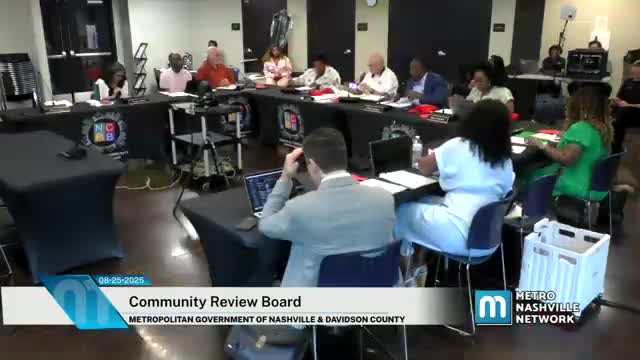
Summary
NCRB reviewed CC2024033 and found Officer Alexandria Herring did not activate body‑worn camera or obtain driver statements at a February 2024 crash; the board accepted OPA’s investigation and endorsed NCRB training recommendations to improve traffic crash documentation.
The Nashville Community Review Board accepted the NCRB review of case CC2024033, which found lapses in initial traffic‑crash reporting by Officer Alexandria Herring and recommended additional training on crash documentation and camera use. NCRB’s presentation said the officer responded to a crash on Feb. 5, 2024, and relied on a witness statement rather than obtaining direct statements from both drivers while on scene. Subsequent corrections to the crash report were made after the complainant notified a sergeant. OPA’s investigation concluded the officer’s initial reports contained inaccuracies; OPA sustained a recommendation for the officer to receive training under MNPD policies governing traffic crash response and recording. Why it matters: NCRB and OPA reviewers said failing to interview involved drivers and not activating body‑worn cameras undermines transparent documentation and can prejudice fault determinations. The board voted to accept the report and to send the findings to the chief of police and the mayor. Key findings and recommendations: OPA concluded the officer violated MNPD policies on traffic crash response and recording; NCRB recommended training on preliminary investigations and consistent activation of body‑worn and in‑car cameras in any investigative or law‑enforcement activity involving the public. The board’s executive director and lead compliance monitor recommended forwarding the accepted report to MNPD leadership for action. Board action: The board moved, seconded and voted to accept the report; members emphasized the role of body‑worn cameras as a transparency tool and asked MNPD to use the case as a teaching example for the traffic division and field training officers.