
Board hears wide-ranging 2025 legislative update; district staff flags changes to DEI programs, truancy rules and employee-investigation process
Get AI-powered insights, summaries, and transcripts
Subscribe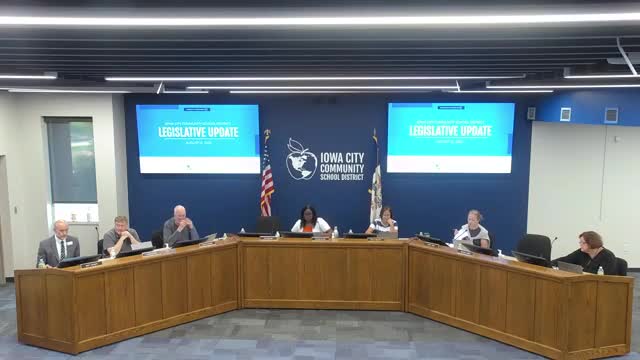
Summary
District administrators told the Iowa City School Board on Aug. 12 that a raft of 2025 education laws will change local practice in several areas, from board training and attendance policy to personnel investigations and school programs.
District administrators told the Iowa City School Board on Aug. 12 that a raft of 2025 education laws will change local practice in several areas, from board training and attendance policy to personnel investigations and school programs. Chase, the district's deputy superintendent, summarized bills and said the Iowa Public Information Board will provide at least one free training on open-meeting laws; the new law also increases fines for knowingly violating open-meeting requirements and may widen the scope of who must be trained. On absenteeism, Chase said revisions in Senate File 277 broadened categories of exempt absence and eliminated the requirement to send certified letters. He told the board the district spent roughly $30,000 on certified-mail notices in the prior year and that truancy referrals to the county attorney have fallen from 133 to 61 since 2021. Administrators said House File 856, the 2025 law affecting diversity, equity and inclusion practices, will require the district to redesign some programs that gave preferential treatment based on race or ethnicity. Chase said the district can continue programs open to all participants but must remove explicit race- or ethnicity-based preferences; he cited the district's Grow Your Own teacher pipeline as an example that will need redesign to be race-neutral. On student-abuse investigations, staff said Senate File 659 transfers responsibility for investigating alleged abuse involving school employees to the Iowa Department of Health and Human Services; DHHS will conduct investigations and the district must place an employee on immediate leave when DHHS accepts a case; a founded case would require termination. Chase said DHHS has up to 30 days to complete investigations under current guidance. Chase also described other 2025 enactments with local effects: a civics-test requirement for graduating classes in 2026–27 with a 60% pass mark (state guidance pending); changes to health- and human-growth curriculum specifying certain instructional materials; a state cellphone law the district already matched with a local policy; and a new optional statute that would allow districts to form multi-agency school safety or care-assessment teams under a policy adopted by the local board. Board members and administrators discussed practical implications, including whether a $12,000 maximum fine for open-meeting violations is assessed against individuals or districts, how to redesign targeted recruitment programs to meet the new DEI law, and the district's next steps for policy changes. Administrators said they are consulting legal counsel and plan to return to the board with draft policy language and implementation details. No formal board action was taken on the legislative items at the meeting; the session was for information and planning.