
California officials unveil plan to counter midterm redistricting, say state will fund special elections
Get AI-powered insights, summaries, and transcripts
Subscribe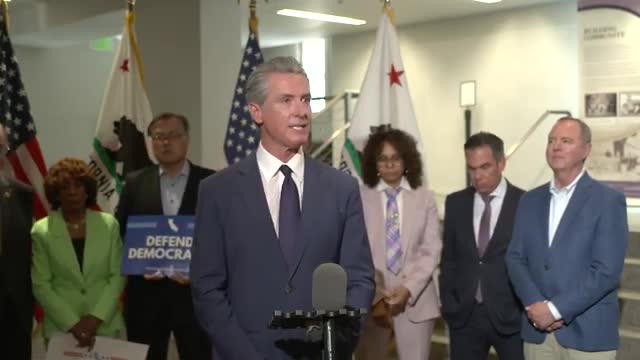
Summary
At a press conference, California’s governor and Democratic federal and state officials described proposed legislation that would trigger a state response if Republican-controlled states redraw congressional maps during the midterms, and said the state would cover the cost of any resulting special elections.
California’s governor and Democratic lawmakers said at a press conference that the state will pursue legislation designed to respond if Republican-controlled states redraw congressional districts during the midterm cycle and that California will pay the cost of any resulting special elections. “The state of California is gonna fund that,” the governor said.
The officials framed their proposal as a defensive measure aimed at countering what they described as coordinated efforts in other states to change district maps midterm. “This is not just about Texas,” the governor said, naming Missouri, Florida, Indiana and other states as places where officials are considering what he called “unprecedented rigging” of elections. He also mentioned a directive from former President Donald Trump and cited JD Vance as an example of out‑of‑state actions tied to redistricting strategy.
Why it matters: supporters said the measure would protect voters and the political representation of communities they say would be targeted by last‑minute map changes. A member of Congress at the briefing said the redistricting push in multiple states is intended in part “to silence Latino representatives and to get rid of African American representatives.”
Details and immediate next steps - The governor said state legislative leaders present at the event believe they can secure a two‑thirds legislative threshold to let Californians decide, saying, “we believe we'll have the 2 thirds to allow the people to decide for themselves.” - Riverside County’s registrar of voters previously estimated a cost of $16,000,000 for a special election; the governor stated the state would cover that expense. At the briefing he described criticisms of the cost estimate as “deeply disingenuous.” - Officials said the measure would include a trigger that activates if a Republican state enacts midterm redistricting intended to alter federal representation; when asked, the governor answered affirmatively that the trigger would apply if any Republican state took such action.
What supporters said Supporters at the event framed the plan as both defensive and a model for other Democratic states. One member of Congress described California’s effort as a “playbook” that other states could emulate, saying the delegation’s Democratic caucus asked California to “lean in” and provide examples for how to respond in their states.
Broader context and claims Speakers repeatedly characterized the redistricting effort as part of a broader strategy by the president and Republican officials to retain power, and several speakers raised concerns about the effects on Latino and Black representation. One speaker urged passage of the federal John Lewis Voting Rights Act as a complementary remedy.
Distinguishing discussion from firm action The press conference announced a proposed legislative response and expressed confidence among attendees that the Legislature could reach the necessary majorities. While the governor stated the state will fund special elections, no formal legislative vote or enacted law was recorded in the transcript provided. Officials said they are coordinating with California’s independent redistricting commission and other Democratic lawmakers on next steps.
Voices from the briefing - “We’re not gonna sit back passively hoping, that somehow conditions align …” — Governor - “They are also doing it to silence Latino representatives and to get rid of African American representatives.” — Member of Congress - “What you heard today was California organized.” — Member of Congress
What was not specified The press conference did not include text of the bill, the precise legal mechanism that would trigger California’s response, an exact legislative timeline, nor a formal legislative vote count. The governor and other speakers expressed confidence about legislative support but did not present a signed bill or enacted statute at the event.
Ending Officials said they expect other states and commissions to review California’s approach if the measure moves forward; supporters described the proposal as both a direct response to actions in other states and a potential template for Democratic officials elsewhere.