
California leaders to ask voters to authorize midterm congressional redistricting to counter Republican gerrymandering
Get AI-powered insights, summaries, and transcripts
Subscribe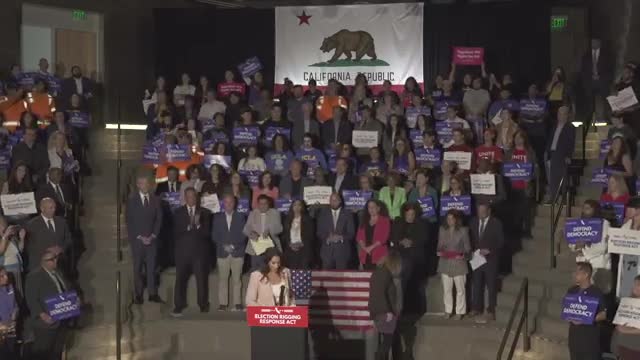
Summary
At a rally in Los Angeles, Gov. Gavin Newsom and federal, state and labor leaders announced plans to place a Nov. 4 special-election measure before California voters to allow temporary congressional map redraws in 2026, 2028 and 2030 in response to Republican-led redistricting in other states.
LOS ANGELES — Gov. Gavin Newsom and a coalition of California elected officials, labor leaders and advocacy groups announced at the Japanese American National Museum’s Democracy Center that they will seek voter approval to allow the state to redraw congressional districts in midterm years to respond to what they called partisan redistricting elsewhere.
The proposal, as described at the rally, would place a measure on a special election ballot on Nov. 4 asking voters to authorize temporary congressional redistricting in 2026, 2028 and 2030; the leaders said the plan also will require two-thirds legislative consent before appearing on the ballot and that the state would return to use of its independent citizens redistricting commission after the 2030 census.
Why it matters: Speakers said Republican-led redistricting in states such as Texas and other actions by the federal administration pose a national threat to equal representation, and they argued California — with the country’s largest congressional delegation and the nation’s fourth-largest economy — must act to protect voting power for communities of color and working families.
At the rally, Rep. Pete Aguilar, chairman of the House Democratic Caucus, described the push as a response to "a Republican-controlled Texas state legislature [that] wants to rig their congressional map" and said, "We will take this fight to the ballot, and we will let the voters decide." Sen. Alex Padilla used a direct appeal to Californians: "Are we ready to stand up for our democracy? Are we ready to speak up for our democracy?" and urged turnout.
Speakers repeatedly tied the proposal to concerns about partisan attempts to entrench power. Sen. Sabrina Cervantes, chair of the state Senate elections committee, said the measure would be a temporary pathway for congressional maps in response to what she described as a power grab in other states and that "if Texas does the right thing and backs off, we will follow suit and our ballot measure will be shelved." Former California redistricting commissioner Sarah Sadhwani cited the state’s community-driven process and said the commission’s maps "passed unanimously" after nearly 40,000 pieces of community testimony.
Labor and advocacy leaders framed the measure as protecting rights and services they said are already under pressure from federal actions. Jody Hicks, president and CEO of Planned Parenthood Affiliates of California, said recent congressional actions would "put economic sanctions on Planned Parenthood health centers" and remove federal payment for nonabortion services that many Medicaid patients rely on. SEIU and other unions pledged organizational support.
Gov. Newsom described the effort as giving Californians "the power to save democracy," urging voters to use the Nov. 4 special election to "stand up to Trump" and to prevent what speakers called legalized efforts to dilute votes in competitive districts. He and other speakers said the plan requires both legislative consent and voter approval and emphasized that it is intended as a temporary, transparent response rather than a permanent change to California’s post-2030 redistricting process.
What leaders said next: Organizers said they will seek the two-thirds legislative consent the state constitution requires for certain election changes and then place a measure before voters at a special election scheduled for Nov. 4. The plan, as described at the rally, is to certify temporary congressional maps for 2026, 2028 and 2030 and then return to the independent redistricting commission for maps after the 2030 census.
Discussion vs. formal action: The event was a public announcement and rally, not a legislative vote. Speakers announced intentions and next steps (seek legislative consent, place a measure on the Nov. 4 special-election ballot). There was no recorded motion, vote, or formal adoption of the measure at the event.
Background: California has used an independent citizens redistricting commission to draw state and congressional maps; speakers said a national independent redistricting framework is the long-term goal. Organizers framed the Nov. 4 measure as a temporary, emergency response to redistricting efforts in other states that they say would diminish the weight of California votes.
— End —