
California leaders move to put new maps to voters after Texas redistricting fight
Get AI-powered insights, summaries, and transcripts
Subscribe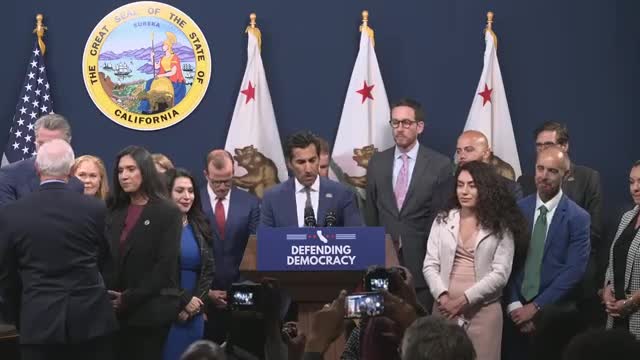
Summary
Gov. Gavin Newsom and legislative leaders said they will sign and implement a package of bills and a proclamation to put proposed legislative maps before California voters in a special election Nov. 4, a move they described as a temporary response to redistricting steps taken in Texas and threats to federal election norms.
Gov. Gavin Newsom said Friday he will sign a package of legislation and a proclamation setting a Nov. 4 special election to submit new legislative maps to California voters, describing the step as a temporary response to recent redistricting actions in Texas and what he and legislative leaders called threats to U.S. democracy.
The action follows votes in the Legislature earlier the same day to approve the package, officials said. Senate President pro Tempore Mike McGuire and an unnamed legislator who opened the event said California’s steps are meant to protect fair elections and preserve voters’ ability to hold elected officials accountable.
The move matters because, officials said, it would bypass changes in other states they view as attempts to entrench one party’s power. “This bill is a temporary measure in response to an urgent threat,” the unnamed legislator said. Mike McGuire said lawmakers were placing “our faith in our fellow Californians” to decide the maps at the ballot box. Newsom said the state will be “the first state in U.S. history” to submit maps directly to voters in this way.
Officials framed the action as a direct response to redistricting steps taken in Texas this week that leaders at the event said gave that state five more U.S. House seats through a process they characterized as partisan. Speakers repeatedly named former President Donald Trump and Texas Gov. Greg Abbott while arguing the Texas actions create a risk of similar tactics being used elsewhere. “They’re coming after mail-in voting to disenfranchise tens of millions of Americans,” McGuire said, citing recent public debate over voting methods.
Speakers also linked the package to broader policy impacts they said would follow if the U.S. House flips under what they described as unfair maps: potential cuts to Medicaid and Medicare, changes in public-education funding and other federal programs. Newsom criticized recent federal actions and said he would sign two measures establishing a special session and submitting maps to voters; he also said a proclamation will set Nov. 4 as the date for the special election.
At the event, speakers referenced a recent U.S. Supreme Court ruling (not named at the podium) and lawsuits filed by Republican leaders; McGuire said the court had rejected one of those suits. Newsom and McGuire contended the package is temporary and meant to “neutralize what occurred in Texas” and “ensure free and fair elections.”
Speakers provided some quantitative claims during remarks: officials said Texas leaders sought “five more house seats,” and the governor cited recent high rates of mail-ballot use in California—statements attributed to speakers on the record. The governor also referenced a federal spending package he characterized as providing $175,000,000,000 for immigration and enforcement-related activities; the event did not produce statutory citations or legislative text in the remarks themselves.
Newsom said he planned to sign the bills and a proclamation and that staff would finalize the formalities to place the maps before voters. He said that after signing the bills he would transition to campaign mode and discuss the special election and implementation details with attendees.
The event combined policy rhetoric about national politics with concrete steps described by state leaders to submit redistricting maps to a statewide vote. Officials framed the package as temporary and narrowly focused on responding to what they described as an immediate threat to election fairness; they did not provide the full text of the bills nor an implementation timeline beyond the Nov. 4 date the governor announced.
The officials’ remarks also raised potential legal and political challenges. McGuire and the governor referenced pending lawsuits and federal actions; they did not provide legal citations beyond references to the Supreme Court and ongoing litigation, and they did not specify how state election administrators would implement the maps if courts intervene. The governor said more work would follow the signings and that staff would “establish the formality” of the special election.
Who spoke and what happened: Gov. Gavin Newsom said he will sign the legislation and an accompanying proclamation to set a Nov. 4 special election; Senate President pro Tempore Mike McGuire and an unnamed legislator opened and framed the initiative; speakers repeatedly blamed actions in Texas and comments by former President Donald Trump for prompting California’s response.
Implementation questions that remain include how the maps will be transmitted to the Secretary of State and county election officials, whether litigation will alter the timeline, and the precise statutory basis for placing maps before voters; those details were not specified during the event.