
Council hears transit scenarios: restoring Sunday service and fleet upgrades would cost millions; zero-emission plan faces funding and timing uncertainty
Get AI-powered insights, summaries, and transcripts
Subscribe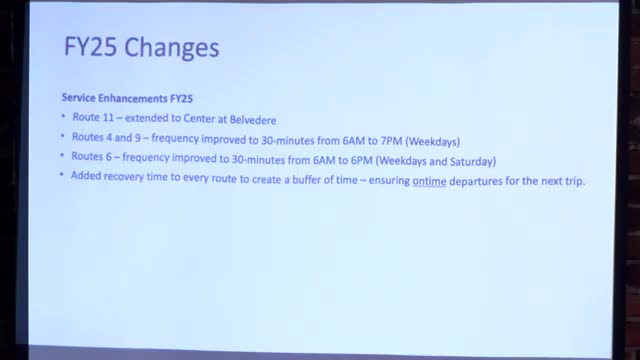
Summary
City staff presented service expansion and fleet scenarios showing restoring Sunday service and increasing frequency require more drivers and vehicles; transitioning to electric or hydrogen buses raises facility and purchase costs and depends on federal/state funding and technical readiness.
City transportation staff briefed Charlottesville City Council on transit service scenarios and the financial and facility implications of restoring pre-pandemic service levels, expanding frequency and transitioning the fleet to zero-emission vehicles.
Staff reviewed current service levels and recovery steps taken since 2018 and identified three knobs for improvement: more frequent service (15-minute intervals on core lines), extended hours (service to 11 p.m.) and restoration of Sunday service. Staff said returning to pre-pandemic Sunday service and extending hours would require adding drivers and vehicles; staff provided illustrative all-in costs for scenarios: the incremental cost to expand to higher-frequency, later hours and Sunday service ranges from the mid‑$10 millions to the high‑$20 millions in total system cost, depending on vehicle type.
Fleet-purchase estimates in the presentation showed diesel buses under recent pricing at roughly $560,000 per vehicle, battery-electric buses at about $1.2 million each and hydrogen buses about $1.5 million each; facility upgrades to support electric or hydrogen fleets are substantial. Staff noted the city's zero-emission transition plan envisions a transition away from diesel vehicles beginning in 2027, but warned the timing and costs depend on available federal and state funding, vehicle reliability and training and maintenance capacity.
Council and staff discussed regional integration through CARTA and the need for a regional revenue source to support expanded service; staff said governance and funding conversations with Albemarle County and other regional partners are ongoing and that a near-term local funding decision is unlikely this year. Members asked for additional scenario analysis, including equity- and ridership-focused options that prioritize higher-frequency service on high-use corridors.