
California and Denmark sign memorandum to expand cooperation on green economy, digital safety and innovation
Get AI-powered insights, summaries, and transcripts
Subscribe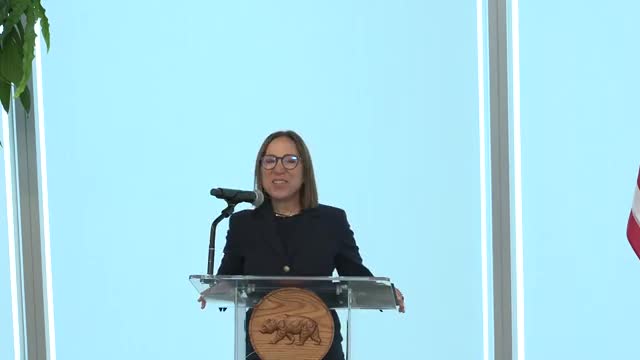
Summary
California and Denmark formally signed a memorandum of understanding in San Francisco to create a flexible framework for cooperation on environmental resilience, green economy, digital safety, cyber development and innovation, with officials from both governments and business delegations present.
SAN FRANCISCO — California and the Kingdom of Denmark signed a memorandum of understanding in San Francisco to establish a flexible framework for strategic cooperation on environmental resilience, the green economy, digital safety, cyber development and innovation. Lieutenant Governor Eleni Kounalakis opened the ceremony and led introductions for the signing, which included Governor Gavin Newsom and Denmark’s foreign minister, Lars Løkke Rasmussen.
The agreement, Kounalakis said, “will establish a flexible framework to support strategic cooperation on environmental resilience and the green economy, digital safety, cyber development, and innovative ecosystems.” The memorandum is framed as a platform for research exchanges, public–private partnerships and trade ties between California and Danish companies.
Foreign Minister Lars Løkke Rasmussen said the agreement builds on years of cooperation and invited Californians to a coming milestone, saying, “I think next year, we will celebrate the twentieth anniversary of our Innovation Center in California. Everybody are hereby invited to take part in the celebration a year from now.” He described Denmark and California as leaders in clean energy, sustainability and design, and said the agreement “lays the foundation for stronger trade.”
Governor Gavin Newsom said the memorandum targets low-carbon growth and sustainable practices. He highlighted collaboration on projects such as the Stanford Groundwater Architecture Project, a cross‑border effort referenced at the ceremony to develop new mapping approaches for groundwater reservoirs in California. Newsom characterized the accord as a tool to “strengthen the ties that have defined our proud past” and to accelerate cooperation on renewable energy and related technologies.
Officials from both delegations — including Denmark’s ambassador to the United States and a Danish business delegation — were on site; the memorandum itself does not, in the ceremony remarks, specify binding funding obligations or concrete procurement commitments. Newsom cited data shared by state staff during remarks about recent clean‑energy milestones for California, describing the state’s progress toward running on clean electricity much of the year; the specific figures were reported orally at the event and are noted in clarifying details below.
The signing was a ceremonial, executive‑level step to formalize the partnership; the memorandum sets a framework for future cooperative projects but does not itself create new statutes or appropriations. After the signature, officials indicated they expect follow‑up work — including research collaborations, business engagement and potential pilot projects — to proceed through standard administrative and contractual processes in both jurisdictions.
Newsom and Rasmussen said they expect increased trade and research exchange under the agreement; specific project timelines and funding sources were not spelled out at the ceremony.