
Council hears update on Charlottesville affordable housing plan; pipeline and preservation challenges flagged
Get AI-powered insights, summaries, and transcripts
Subscribe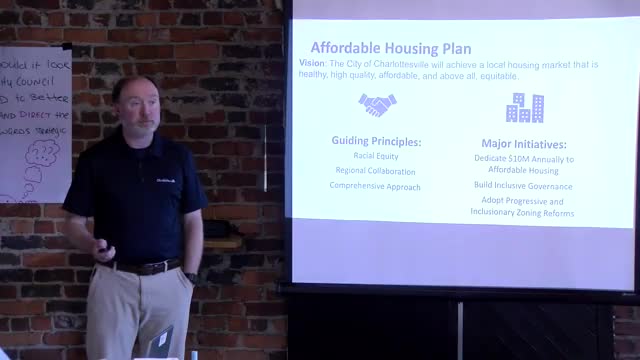
Summary
City staff reported progress on the affordable housing plan but said preservation of deeply affordable units and administrative capacity remain challenges; two developments with expiring affordability covenants were identified as near-term risks.
City staff updated Charlottesville City Council on implementation of the city's affordable housing plan during the Aug. 15 retreat, reporting that the city has met or exceeded some commitments but still falls short on the deepest affordability tier and on long-term preservation.
James (city staff) said the city has been investing at levels above many peer communities and that capital commitments in the CIP already accounted for a portion of the plan's early funding targets. The plan originally called for an average $10 million annually (including a $7 million direct housing investment target) to support production and preservation; staff calculated an updated estimated annual need of about $13.6 million to meet all targets.
Staff noted progress on several fronts including adopted zoning reforms (now subject to a legal challenge) and projects moving toward production. However, they identified two near-term preservation risks: Hearthstone (about 200 units) and another property of roughly 160 units whose affordability covenants could expire in 2026. Staff said those expirations do not automatically mean loss of affordability but that each property is a preservation risk requiring advance planning.
Council and staff discussed barriers to smaller-scale housing production, including stormwater and other development requirements that raise per-unit costs on small projects and can deter smaller builders. Staff said additional administrative capacity and a housing project pipeline dashboard are needed to track how city dollars are tied to units, AMI levels and timelines.
Staff emphasized a multi-pronged approach: continuing subsidy and preservation spending, removing regulatory barriers that drive up costs for small-scale projects, and building systems to measure outcomes for deeply affordable units.