
Council retreat surfaces split over single comprehensive shelter versus distributed low‑barrier sites
Get AI-powered insights, summaries, and transcripts
Subscribe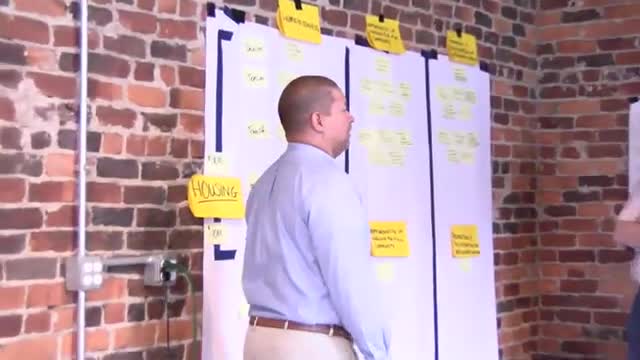
Summary
Councilors and staff debated whether to prioritize a single comprehensive low‑barrier shelter with on‑site services or multiple smaller sites; participants emphasized the need for permanent supportive housing and clearer funding while noting neighborhood resistance and cost trade‑offs.
City councilors and staff used a future‑casting exercise at the retreat to surface competing approaches to homelessness, including whether to develop a single, comprehensive shelter with integrated services or smaller, distributed low‑barrier shelters. Sam (city staff) framed the homelessness impact area and noted the retreat’s housing 10‑year planning anchor of $110,000,000. Councilors and staff identified a set of tensions: neighborhood resistance (‘‘NIMBY’’) versus the need to house people, the higher cost of lower‑barrier shelter depending on site and the trade‑off between investing in multiple sites versus concentrating services in a single location. Several participants suggested prioritizing a single comprehensive shelter with on‑site services to consolidate outreach and supports. One participant argued that a ‘‘low or no barrier shelter’’ should be combined with co‑located service providers so residents can get mental‑health and addiction assistance in place. Participants also noted the role of permanent supportive housing and the city’s limited capital. One councilor observed that homelessness is fundamentally a housing problem and that ‘‘the ultimate solution is create more housing.’’ Staff clarified that current capital budgets include only limited annual allocations: transcript discussion referenced approximately $10,000,000 per year in housing budget context and a separate $3,000,000 in capital funds currently budgeted for preservation work; participants urged evaluating whether concentrated ‘‘moonshot’’ investments could produce larger downstream gains than spreading funds thinly over many years. No binding decision was taken at the retreat; the discussion produced themes staff will use to develop budget options and implementation plans. The transcript shows a clear directive to move from discussion to staff work: the facilitator and staff asked councilors to ‘‘direct and inform’’ the CMO’s office so staff can prepare options with trade‑offs, costs and timelines for future council action.