
City council upholds BAR denial of demolition for 1301 Wertland Street, citing historic significance
Get AI-powered insights, summaries, and transcripts
Subscribe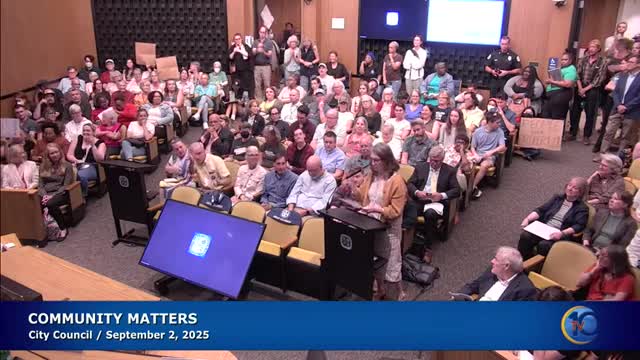
Summary
Charlottesville City Council upheld the Board of Architectural Review’s denial and refused to allow demolition of the Wharton (Wurtenbacher) House at 1301 Wertland Street, citing the building’s 1840s origins, architectural integrity and its role as a contributing resource in the Wertland Street historic district.
Charlottesville City Council on Monday denied an appeal that would have allowed demolition of the 19th-century house at 1301 Wertland Street, sustaining a unanimous Board of Architectural Review decision to preserve the building.
The matter reached council after months of debate. Preservation advocates and neighbors urged protection at the meeting, while the property’s applicant argued the site is an appropriate place for higher-density housing near the university and presented a feasibility envelope estimating up to several hundred bedrooms in a redeveloped project.
Jeff Warner, the city’s preservation and design planner, briefed council on the legal criteria the Board of Architectural Review (BAR) must apply in demolition requests under the city code, noting the house was built circa 1842–43 and is listed as a contributing structure in the Werten (Wertland) Street historic district on the Virginia Landmarks Register and the National Register of Historic Places. He said a 2023 BAR-approved site plan for adjacent multifamily housing had shown a way to accommodate increased density while retaining the house. “The house was constructed circa 1842 … it is a contributing structure within the Wertland Street historic district,” Warner said.
Speakers at the meeting described the house as one of the city’s earliest surviving dwellings, tied to William Wurtenbacher, who served as a university librarian in the 19th century. Preservation Piedmont urged council to respect the BAR’s finding that the structure met preservation criteria. “This is not a choice between disparate goals. Better housing and the preservation of our community go hand in hand,” said Mary Joyce Scala of Preservation Piedmont during public comment.
Representing the appellant, attorney Steve Blaine told council the site is zoned for high-density residential use and argued the site is a logical place to concentrate student housing in order to reduce transportation demand. He also said modern documentation (a detailed 3-D scan) could preserve the building’s record if demolition were allowed. “The city council… is the body that can determine which of those two policies take priority in this instance,” Blaine said.
Board of Architectural Review Chair James Zemer explained the BAR’s unanimous 7–0 denial and described the house as an anchor of the district. He said the 2023 compromise plan had attempted to balance preservation and growth.
Councilors debated competing goals of increasing housing supply and preserving historically significant structures. Several members said they relied on the BAR’s preservation judgment and on the building’s age, architecture and documented associations in deciding the outcome. One councilor added that the 2023 approved plan demonstrated a path to add housing without demolishing the house.
By motion and second, council voted to deny the COA for demolition, sustaining the BAR decision. Council discussion noted that a property owner could later seek sale remedies in the code (an owner's ability to demolish if the property is offered for sale at fair market price to a preservation-minded buyer and no bona fide purchase occurs within 12 months). Council members said future development proposals that preserved the structure could still be considered under the code.
The decision preserves the Wharton (Wurtenbacher) House and sends a signal that, in this case, city preservation guidelines and structure age and associations outweighed the applicant’s redevelopment arguments. The owner retains procedural rights under the city code, including the sale provision and future appeals to the circuit court.