
Charlottesville council pauses proposed citywide camping, storage ordinance after wide public opposition
Get AI-powered insights, summaries, and transcripts
Subscribe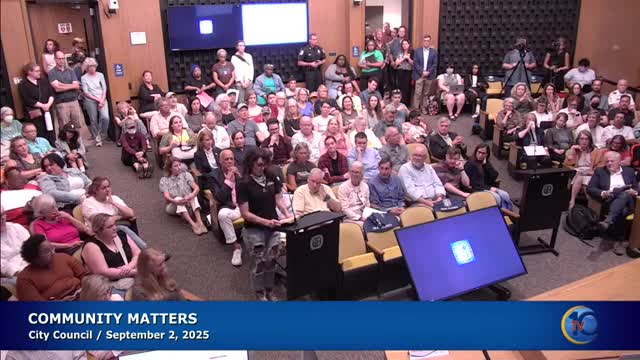
Summary
City Council on first reading heard hours of public comment on a proposed ordinance that would ban camping and storage on city property; council voted to table the measure and asked for more planning and outreach before any new enforcement policy moves forward.
Charlottesville City Council on Monday heard speakers for and against a proposed ordinance that would prohibit camping and the storage of personal property on city-owned land and public rights of way, then voted to table the measure for further work and discussion. The first reading at the meeting followed weeks of community emails and a months-long internal drafting process by city officials.
The city’s police chief presented the proposed ordinance as a legal framework to address unsafe or hazardous encampments and to give staff a consistent process for inspection, outreach, cleanup and storage of personal property. “This process began on 04/03/2025 … The perspective we heard comes from all sides and they reflect just how complex, emotional this topic is for our community,” the chief told council. The draft ordinance would make certain violations a Class 4 misdemeanor and set protocols for notice, outreach and storage of items removed from encampments.
The significance lay in the public reaction. Scores of residents, social-service providers and advocates urged council not to criminalize people without homes and to prioritize housing solutions. “You simply cannot punish people out of poverty, and you cannot legislate away human need,” said Beth Robinson, a resident speaking in opposition. Joshua Baloo, who identified himself as a person who has been unhoused in Charlottesville, said punitive rules would deepen hardship and that people need low-barrier shelter and services instead of citations.
Providers and advocacy groups asked council to delay action until there are tangible alternatives. Shayla Washington, executive director of the Blue Ridge Area Coalition for the Homeless, asked the council to delay voting on the ordinance until more concrete plans for a year-round low-barrier shelter are developed and, in the interim, to designate up to three city-owned camping sites with outreach, service access and site monitoring. "Handing out Class 4 misdemeanors to people who have no designated place to lay their head at night is cruel and inhumane," she said.
Some downtown business representatives backed stricter rules for the mall area, arguing unmanaged encampments and clutter had discouraged visitors and driven down sales at longstanding businesses. Greer Akenbach, executive director of Friends of Charlottesville Downtown, told council she supported an ordinance and a designated camping area outside the business district until more shelter beds exist.
Council members and city staff emphasized housing as a long-term solution but expressed differing views about timing and enforcement. Several councilors said they supported the goal of safety and public health but were not prepared to adopt criminal enforcement before a practical plan is in place for where people would go. Council voted to table the ordinance pending further work, including additional outreach and planning on shelter options.
The council’s vote ends the immediate push to adopt the draft ordinance; it can be reintroduced in a future session. For now, city staff said they will continue outreach with homeless services providers and explore interim measures. The chief said current practice already includes a city container near the Salvation Army for residents to store belongings, and the department will continue to document and photograph sites and to coordinate outreach during any cleanups.
Council members and community groups urged continued work on a year-round low-barrier shelter, expanded low-income housing and partnerships with nonprofit providers to pair any enforcement changes with immediate, accessible alternatives for people experiencing homelessness.