
Residents urge council to block 11‑story student housing plan that would loom over West Haven
Get AI-powered insights, summaries, and transcripts
Subscribe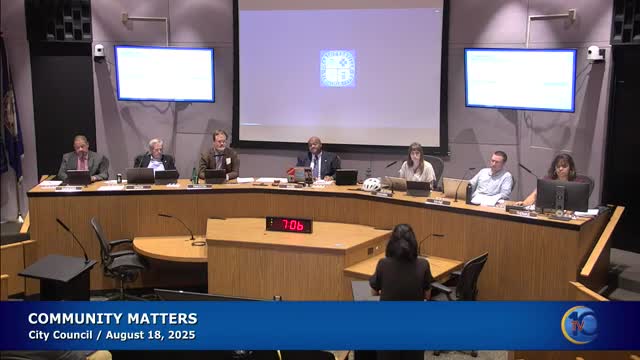
Summary
Residents and neighborhood advocates told City Council that a proposed 11‑story student housing development on West Main Street would overshadow West Haven and deepen historic patterns of exclusion; city staff reminded the public that the site’s CX‑8 zoning permits 11‑story development by right.
Scores of residents and community organizers addressed the Charlottesville City Council during public comment on Aug. 26 to oppose a proposed luxury student housing development on West Main Street, saying an 11‑story building would physically and symbolically loom over the West Haven and Tenth & Page neighborhoods and would repeat historic harms tied to urban renewal.
Speakers framed the project as more than a single development. Wendy, a community organizer with the Charlottesville Public Housing Association of Residents, said the structure would sit “right on top of the West Haven residents’ proposed walkway,” obstructing an accessible connection to West Main Street that residents have identified as a priority during West Haven redevelopment. “This building is the Standard, the Lark, the Flats — this is the dairy market expansion,” she said, listing past projects that neighborhood speakers said had repeatedly encroached on historically Black neighborhoods.
Attorneys and planning staff at the meeting noted the site’s current commercial zoning classification — CX‑8 — permits 11 stories and unlimited density by right. A city official explained that, under current zoning, the only remaining discretionary review would be by the Board of Architectural Review; a special‑use permit mechanism that previously allowed negotiation of community benefits was removed by the updated zoning. A council speaker said that to make the community’s voice decisive, the zoning designation for the site would need to change.
Other speakers invoked local history: several described Vinegar Hill and the construction of West Haven in the 1960s — a period residents say involved deliberate physical separation of predominantly Black neighborhoods from the city core — and argued the city should not allow new development that replicates that pattern. A representative of the UVA Alumni Association (speaking earlier on another agenda item) and an alumnus who had studied architecture noted the university’s recent and historic influence on development patterns near the university.
Speakers asked council to prioritize “good density” and “deep affordability” rather than luxury, transient student housing; they sought meaningful community engagement, community benefits that produce permanently affordable units, pedestrian connections to West Main Street, and measures to reduce displacement pressure. Members of the public asked council to consider zoning changes for the corridor and to restore or create procedural mechanisms that allow community benefits to be negotiated rather than leaving the outcome to by‑right development.
Councilors and staff did not take a legislative action on the project at the Aug. 26 meeting; staff reiterated that the current zoning allows the height and density in question and reminded the public that the Board of Architectural Review is the remaining discretionary body for design review. Councilors suggested that residents seeking a binding role in development outcomes should pursue zoning adjustments and emphasized the limits of the city’s regulatory authority when sites are already zoned for a given scale.
The public comments close a round of intense neighborhood concern and set up a likely policy discussion over zoning tools, community benefits agreements and whether and how the city should pursue zoning changes to limit height and density on sites along West Main Street.