
Blue Ridge Juvenile Detention director outlines education, mental-health and post-dispositional programs
Get AI-powered insights, summaries, and transcripts
Subscribe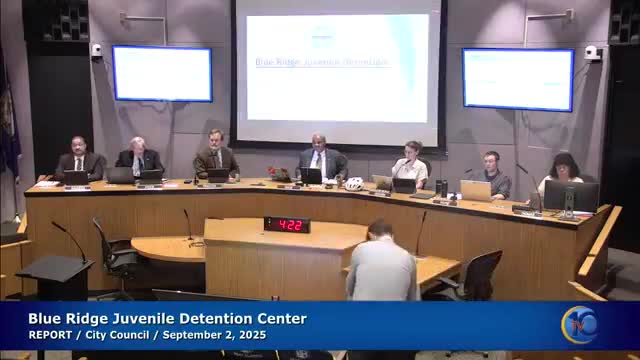
Summary
Director Jay Volley presented the facility’s services, capacity, education model, mental-health supports and community partnerships; council members asked about length of stay trends and recidivism.
Jay Volley, director of the Blue Ridge Juvenile Detention Center, told the council on Sept. 2 that the center provides a structured environment with education and mental-health services and serves as a local alternative to long-distance juvenile corrections. “Students receive 6 hours of instruction daily exceeding the 5 and a half hour legal requirement,” Volley said, describing the center’s year-round school program, which operates 11 months and is staffed by Albemarle County Public Schools teachers assigned to the facility. Volley said Blue Ridge is a 40-bed detention center that serves males and females ages 10 to 21 and is governed by a multi-jurisdiction commission with Albemarle County as fiscal agent. He described a range of services: medical screening and on-site nursing, weekly psychiatrist visits for medication management, a full-time clinician and a greenhouse program used for therapy. The center offers post-dispositional programs (three-to-six month alternatives tailored to needs), the Community Placement Program for youths committed to the Virginia Department of Juvenile Justice, and a CAP assessment program that provides 21–30 day evaluations for placement planning. Council members asked why average length of stay has increased since before the pandemic. Volley attributed the trend to changes in DJJ policy after a 2014 transformation and to new minimums set by successive DJJ directors that have lengthened stays for lower-level offenses. He added that alternative placements and local services can reduce the need for long out-of-area commitments. Volley described educational outcomes: small class sizes, individualized attention, high graduation rates for certain program participants and career-technical certificates available to residents. He said the center emphasizes in-person instruction over online learning and recently hired a transition specialist to support students returning to their base schools. The presentation included a list of community partners providing services and volunteer programming. No council action was taken; council members thanked Volley and discussed follow-up interest in how education and reentry services could be expanded to reduce recidivism.