
City Council backs Avon Street multimodal plan, accepts loss of on‑street parking
Get AI-powered insights, summaries, and transcripts
Subscribe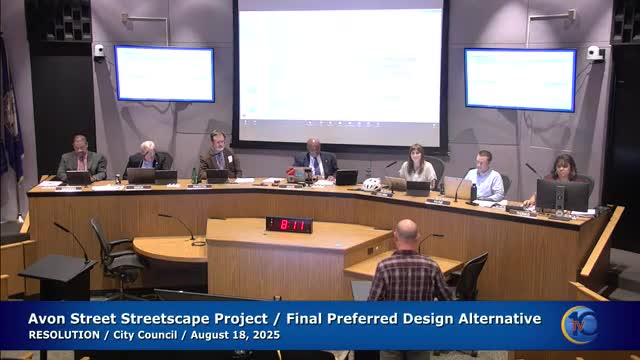
Summary
Charlottesville City Council on Aug. 26 endorsed a single‑side shared‑use path (Alternative B) for the Avon Street multimodal improvements, accepted the loss of roughly 15 on‑street parking spaces in the project area and agreed to take ownership of a new pedestrian bridge over Morse Creek.
Charlottesville City Council on Aug. 26 endorsed a revised design for the Avon Street multimodal improvements, instructing the Virginia Department of Transportation to proceed with Alternative B — a single shared‑use path on the east side of Avon Street — and accepting that the project will remove on‑street parking in the project corridor.
The choice prioritizes a protected shared path linking the Rivanna Trail and the city’s trail network while staying within the SmartScale funding award. Transportation Planning Manager Ben Chambers told council VDOT estimated the original two‑side design (Alternative A) would exceed the city’s awarded funding and that Alternative B reduces right‑of‑way needs and retaining‑wall construction. “This alternative is within our means and gives us buffer against further cost escalation,” Chambers said.
The decision matters because the project aims to improve safety for pedestrians, bicyclists and transit riders on the 0.4‑mile stretch between Druid Avenue and Avon Court, where speed limits transition from county to city. Chambers said the project includes a new pedestrian bridge over Morse Creek; the council also agreed the city will assume ownership and maintenance responsibility for the bridge if built to city rather than VDOT vehicular standards.
The council heard multiple public comments at the meeting from residents who live on the lower portion of Avon Street and from homeowners in a 15‑unit planned development who said the plan would remove about 15 on‑street spaces they currently rely on. Resident Jacob Woods, who owns property at 1458 Avon Street, said loss of those spaces would have a disproportionate impact on households that have only a single on‑site parking space and cited traffic‑safety concerns tied to speeding on the hill. New resident Hannah described daily challenges carrying groceries and pushing a stroller up the hill and said loss of nearby parking would impede accessibility.
Council members and staff discussed mitigation options including pedestrian access improvements that could shorten walking routes and the possibility of studying permit parking for nearby blocks. Council members emphasized that on‑street parking is a public asset, not a private right, but acknowledged the impacts on residents and asked staff to explore localized mitigation — for example, adding pedestrian cut‑throughs, studying neighborhood permit parking, and coordinating bus stops and transit route adjustments.
Councilors also discussed lowering design speeds and the practical steps to achieve slower travel, noting technical guidance such as the 85th‑percentile rule is not an absolute legal limit and that complementary design elements are necessary to change driver behavior. Chambers said VDOT and city staff had already examined sight lines and intersection safety and that bus stop realignment on Route 2 is being considered to improve transit access to the corridor.
The motion adopting Alternative B passed after a roll‑call vote; the clerk recorded the motion as the council’s preferred alternative and directed staff to transmit the resolution to VDOT so the design phase can proceed with right‑of‑way and utility work ahead of construction (targeted to start in 2028 with an approximate 2029 completion).
Council members asked staff for follow‑up reporting on parking mitigation ideas, potential permit parking pilots and confirmation of maintenance costs for the bridge before final design is executed.
The decision moves a long‑planned bike‑pedestrian corridor forward while exposing the city to short‑term neighborhood impacts that staff agreed to study and try to mitigate.