
Charlottesville council tables proposed ordinance to ban camping, citing need for shelter plan
Get AI-powered insights, summaries, and transcripts
Subscribe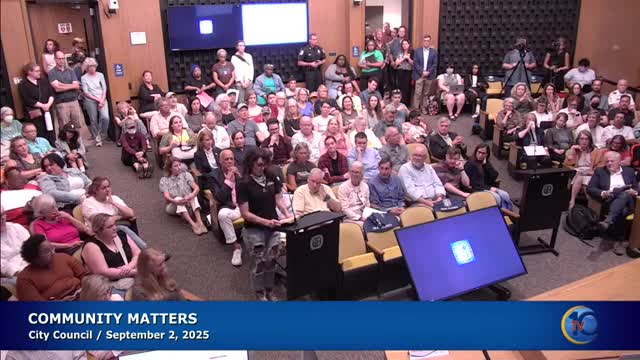
Summary
After hours of public comment, the City Council voted to table a first-reading ordinance that would have made camping and storage on city property a class 4 misdemeanor, saying further work is required to identify shelter options and community partners before moving forward.
Charlottesville City Council on Tuesday tabled a proposed ordinance that would have prohibited camping and storage of personal property on city property and public rights-of-way, after hours of public comment and debate about whether enforcement would criminalize people without homes. The chief of police, city staff and dozens of residents, service providers and business owners weighed in; the council voted to delay action and direct further stakeholder work before pursuing any new enforcement measures.
The proposal, presented by the Charlottesville Police Department, would have created a framework for responding to hazardous encampments, required a posted 10-business-day notice before non‑emergency removal, and permitted storage of seized items for up to 60 days before disposal. It also specified that violations would be a class 4 misdemeanor with fines of up to $250. Chief Kochis told council, “The reality is that long term solutions need to center on housing,” and framed the draft law as a tool to address immediate hazards and consistent city responses.
Why it matters: Councilors and many speakers said the ordinance risks punishing people for lacking shelter unless it is paired with new, accessible housing or permitted camping sites. Speakers asked whether the city has safe alternatives — a recurring question council members said must be resolved before moving forward.
Public comment ranged from residents who said criminalization would trap people in cycles of fines and warrants to business representatives who said downtown safety and commerce have been harmed by some encampments. “You simply cannot punish people out of poverty,” Beth Robinson told the council, describing past nights she spent without shelter and urging “solutions rooted in dignity.” Joshua Baloo, who said he has been homeless since 2017, said some people rely on flexibility outside shelter rules to maintain jobs and family contacts.
Service providers asked the council not to pass the ordinance until a year‑round, low‑barrier shelter is secured. Shayla Washington, executive director of the Blue Ridge Area Coalition for the Homeless (BRAC), urged delay and proposed interim steps: designate up to three city-owned camping sites with outreach and basic services, continue daily outreach, and form a working group that includes city staff, police and nonprofit providers. “Handing out class 4 misdemeanors to people who have no designated place to lay their head at night is cruel and inhumane,” Washington said.
Police and legal staff described operational details in the draft standard operating procedures (SOP): priority responses to immediate hazards (flood‑prone sites, fire risk) with 24‑hour removals where public safety is endangered; photographs and documentation of cleanups; outreach visits between notice posting and cleanup; and free short‑term storage for property the city removes. Chief Kochis said the city currently offers a storage container near the Salvation Army and will continue to store and tag belongings for later retrieval.
Council debate focused on timing and implementation. Several members said they support stronger outreach and an eventual legal framework that does not punish people who lack shelter, but they were not satisfied that the city currently has the permanent housing capacity needed to offer legitimate alternatives. Councilors asked staff to convene more formal discussions with nonprofit providers, funders and neighborhood representatives before returning with a revised policy.
The council’s action: a motion to table the ordinance passed; council directed staff to continue negotiations with service providers, develop shelter and interim‑site options, and return with a recommended path that ties any enforcement to concrete housing alternatives and clearer SOP safeguards. Staff and providers also agreed to expand outreach and documentation practices in the interim.
What’s next: Councilors emphasized budgeting and partnerships will be needed for any shelter or sanctioned camping sites, noting construction, acquisition or operations would require new funds and community agreements. Multiple speakers urged the council to prioritize funding that increases year‑round, low‑barrier shelter capacity rather than enforcement alone.
Ending: Councilors said they will not vote on the ordinance at the next meeting and encouraged continued public input; several asked residents and nonprofit partners to participate in a working group to produce an implementation plan that addresses both public safety and housing access.