
HCAI webinar outlines Song Brown PCR application, deadlines, $31 million in funding
Get AI-powered insights, summaries, and transcripts
Subscribe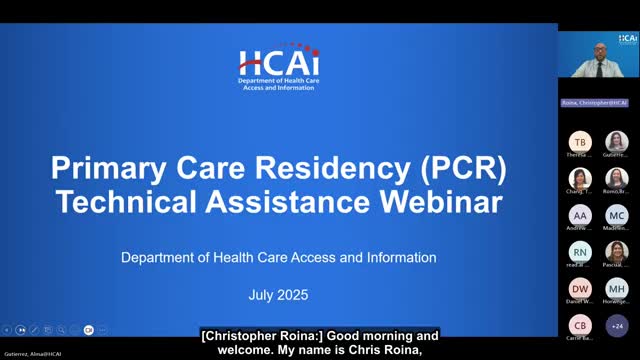
Summary
Health Care Access and Information staff held a webinar to guide applicants through the Song Brown Primary Care Residency (PCR) grant application, eligibility, deadlines and scoring; presenters emphasized new application rules, funding breakdowns and document requirements.
Health Care Access and Information (HCAI) held a webinar to walk applicants through the Song Brown Primary Care Residency (PCR) Program application, deadlines, funding categories and scoring changes, and to answer applicant questions about documentation and eligibility. Chris Romina, Lead Communications Analyst for Health Workforce Development, opened the session and invited Brianna Romo, Grants Officer for the Song Brown PCR program, to present program and application details.
The Song Brown PCR grant provides state-administered funding to training programs that educate and train primary care providers to work in medically underserved communities and at sites that serve Medi‑Cal patients. “The PCR program provides grant opportunities that will result in funding to organizations to educate and train primary care providers to work in underserved communities,” Romina said.
Why it matters: The program this cycle has $31,000,000 available and funds residency slots and teaching health center operations that directly affect where new primary care clinicians may practice. During the webinar, Romo walked attendees through filing requirements, eligibility for new and expansion slots, application mechanics in the online portal, and common errors that can delay award agreements.
Key program and application details
- Funding and categories: HCAI staff said total available funding is $31,000,000, allocated as follows: $18,600,000 for existing programs, $5,600,000 for teaching health centers (THC), $3,300,000 for expansion slots, and $3,300,000 for new programs. For new programs, the maximum award is $1,000,000; for “new with match” awards, the maximum is $2,000,000 and requires the applicant to match 25% of the award. Romo provided a match example: a $2,000,000 award requires a $500,000 match (total budget $2,500,000).
- Dates and deadlines: Romo said EAP registration is open and that the application opened on Friday, July 25. An early submission review will be offered on Aug. 27; the application window closes Sept. 8 at 3 p.m. Applicants were urged to submit early to allow time for corrections.
- Eligibility and documentation: Applicants for new programs must have completed ACGME-related phases (a–d) as described in the application materials or be in the process of applying for sponsoring institution accreditation; applicants for “new with match” must have completed phases a–c (or be in process). Applicants were told to verify that the organization name and address match IRS records, to provide authorized signatory names, and to confirm facility types and payer‑mix data for primary outpatient training sites. Uploads may take up to 15 minutes; once an application is submitted it cannot be edited.
- Portal roles and permissions: Romo explained that account holders are assigned a grant preparer role by default; only accounts with the program director role may initiate and submit applications. Program directors can assign grant preparers and may view, edit and submit applications, payment certifications and final reports; grant preparers can view and edit but cannot submit.
- Application content rules and changes this year: The presenters noted that the import feature that previously copied training sites or graduate entries from prior applications has been removed. Underrepresented-in-medicine data must still be provided for reporting, but those fields will not be scored this cycle. Payer-mix percentages must be whole numbers (no decimals) and need not total 100 percent. Applicants should list primary outpatient continuity training sites only; out‑of‑state graduate practice-site data is optional and separate from in‑state graduate reporting.
- Scoring and thresholds: Romo said the minimum scoring threshold is 50 percent of the total possible points. For the PCR existing/expansion/THC categories the total possible points this year is 90 (threshold = 50% of that total); for new programs the total possible points is 111 (threshold = 50% of that total). She cautioned that meeting the minimum score does not guarantee funding because final awards depend on available funds.
Issues and clarifications raised in Q&A
- Signatories and who must submit: For applications, Romo said no external signatory is required to start an application; the program director must initiate and submit. She recommended that organizations verify authorized signatories with their finance office to avoid delays if awarded.
- Import feature removal: Romo said the import feature was disabled because “we did have a lot of applicants who were not completing it correctly, or updating it. We just want to ensure that all of the information we're receiving is accurate and up to date.”
- Graduate reporting: Staff confirmed there are fields to enter graduates practicing both in California and out of state; the application separates those entries and requests practice-site information only for graduates practicing in California.
- Slot changes vs. expansion: Staff clarified that increasing an approved first-year slot from six to seven would count as a one-slot expansion for that additional position.
- Allowable uses: Romo said funding is intended to support resident training and may be used to pay faculty time to precept residents. She also clarified that precepting does not itself count as “primary care” for graduate placement reporting and that there is no weekly hour requirement for ambulatory primary care reported for graduates.
No formal board actions or awards were made during the webinar; the session was informational and included a question-and-answer period. Presenters repeatedly directed applicants to the Song Brown PCR grant guide, technical assistance materials and the online funding portal for details, and they said they will post the webinar recording and materials on the Song Brown program web page within seven to 10 business days.
Ending: Applicants were encouraged to read the grant guide and technical assistance materials carefully, to register and confirm their portal account role early, and to use the early submission review on Aug. 27 if possible. The application window closes Sept. 8 at 3 p.m.